In Mallorca, overtourism is the result of decades of policy choices repeatedly prioritising short-term profit over long-term protection.
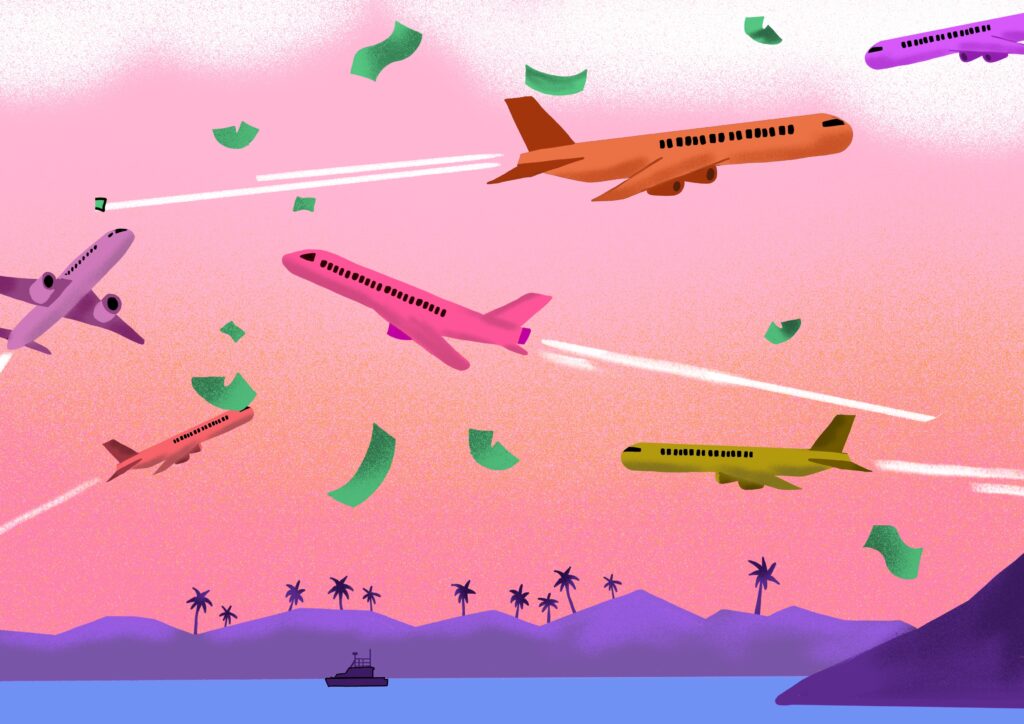
Mallorca is a global hotspot: one in five international travellers to Spain arrive in the Balearic Islands. During peak season, a plane lands every 90 seconds, giving it the highest air traffic intensity in the EU. For an island of just over a million residents, tourists can outnumber locals by fourteen to one. It is a place synonymous with sun, sea and fiesta—for teenage ravers, super-yachts and family finca getaways.
Criticism of tourism has long been taboo in Spanish society as it has brought huge amounts of wealth into the country. According to CaixaBank, in 2023, Mallorca’s GDP grew 3.8 percent thanks to tourism— well above the Spanish average. Tourism generates roughly €20 billion annually and is the island’s largest employer, in an economy revolved around services and the property market.
This growth was by design, decades in the making. In the 1960s, following Franco’s victory in the Spanish Civil War, the fascist regime identified the rural Balearic Islands as sources of foreign exchange, launching campaigns to attract overseas visitors. It was the beginning of the “package holiday”. Landowning elites sold off their estates to developers, and with poor planning regulation, hotels and apartment blocks sprouted across Mallorca’s coastline and hillsides. The EU deregulated airlines in the 1990s, opening the floodgates of cheap flights. Over time, three sectors—hospitality, transport and construction—came to dominate the island’s economy and politics. Today, the government courts international operators at travel fairs, and pays social media influencers to promote Mallorca on Instagram. Major companies like Ryanair and Jet2 also wield considerable influence.
But easy, seasonal cash is no picture postcard of a resilient, dignified economy. Scientists, activists and politicians are at pains to point out the true cost of this machine on society and nature. “It’s like a mirage” says Fernado Valladares, a biologist and professor at the Spanish Council for Scientific Research (CSIC). “You think that because there are so many flights, so many people — people with a lot of money — that something will be left behind…but it leaves very little.”
MÉS per Mallorca, a left-wing, eco-socialist party, explains “we have an economic model demanding a massive amount of low-skilled workers who have poor labour conditions, work half of the year and hence have low incomes.” While tourism supports over 150,000 people, this is a monoculture of blue-collar jobs: taxi drivers, receptionists, gardeners, waiters, and cleaners. According to Fundació Impulsa Balears, although visitor numbers doubled from eight to sixteen million between 2000 and 2015, during that same period average income per person fell by around 1.2 percent.
The island is currently in a housing crisis, as rents have risen by around 50 percent over the last decade, alongside a chronic lack of social housing and population growth. Houses are bought, redeveloped and sold as second homes to foreigners. Locals want their piece of the pie too; many turning their apartments in Mallorca’s historic centre, Palma, into Airbnbs and moving elsewhere. “Where you once had the tailors, the hardware store or the local bar where old men sat together, these are now souvenir shops, trendy cafes or luxury outlets” says Cristina, a resident of 40 years, “it is not a real city, it’s a tourist resort.” MÉS estimates 65 percent of shops in Palma’s center now cater primarily to tourists. The situation has pushed many residents to the outskirts, with reports of people living in their cars. “Our essential public sector workers—doctors, judges, teachers, police—cannot afford to live here” warns Fernando.
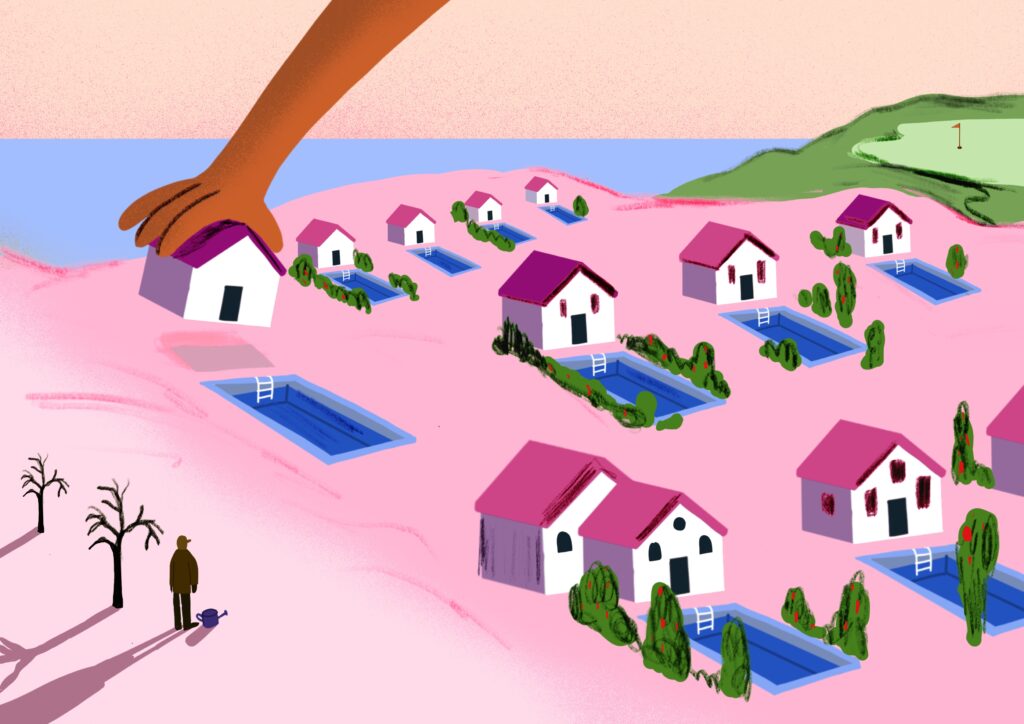
There is a toll on the environment too, with resources and waste used and produced unequally. Each tourist consumes one in every four liters of water in the Balearics, uses five times more energy and produces twice the carbon footprint of a local, according to Mallorca Sustainability Observatory. While swimming pools are kept full and golf courses lush, the island experiences chronic drought every summer. The sheer amount of bodies in one place puts pressure, not just on roads and beaches, but on sewage systems and waste facilities, which seeps into the island’s ecosystems. The landscape restoration charity Commonland, found thousands of champagne bottles on the Mallorca’s seabed.
The dramatic pine-covered cliffs and turquoise waters that visitors flock to see are changing. Mallorca is getting hotter, with heatwaves and forest fires more frequent. The summer of 2025 saw sea temperatures 4.7 degrees above normal, according to The Balearic Islands Coastal Observing and Forecasting System (SOCIB). A Halifax Travel Insurance study warns by 2030, Mallorca may be too hot and dry for the traditional all-inclusive. “The islands are very vulnerable because they are a closed space,” explains Fernando “continents can rearrange activities and urban planning; an island is what it is.” Every year, Southern Spain experiences las danás: intense, short-lived storms caused when cold air at high altitude meets warm air over the Mediterranean. “This natural phenomenon is being amplified by climate change, resulting in torrential, catastrophic downpours,” says Fernando, that lead to deadly flash floods and soil erosion.
“It’s like a mirage. You think that because there are so many flights, so many people — people with a lot of money — that something will be left behind… but it leaves very little.”
Despite this, many residents become nervous when tourism numbers drop. The island is entirely economically dependent, despite the social strain and environmental stress. However, it is this very phenomenon—where what fuels the island is also what threatens its very existence—which has brought degrowth to the fore.
Degrowth is defined as the deliberate scaling back of certain economic activities to protect the environment and improve quality of life. Regional interest in degrowth emerged in the mid-2010s, inspired by Spain’s powerful anti-austerity movement (namely, 15-M), post-2008 financial crisis. Environmental and citizen platforms such as Tot Inclòs and Terraferida linked overtourism to inequality, resource depletion, and land commodification. Their work exposed the true scale of corporate-run Airbnb rentals and unregistered flats contributing to rising housing costs, forcing the government to revise official statistics. Having sparked national debate, environmentalists lobbied government and mobilised residents through protests and campaigns—most notably the May 2024 march in Palma, which drew 10,000 residents and made international media headlines.
This early period of activism brought degrowth into the political sphere. The concept was taken up by the left-wing government in office from 2015 to 2023 and appeared in policy discussions, particularly within MÉS, which was a member of the governing coalition and oversaw the Balearic Department of Tourism.
“One of our key achievements was in 2022 when we inserted degrowth into the new Tourism Bill”, says MÉS. This law, designed to embed sustainability into the tourism sector, meant “for every new bed added, two existing beds must be removed, gradually reducing the overall number of tourists the islands can accommodate.” The law also froze new short-term rentals in Palma and limited cruise ships—which were disgorging up to 12,000 visitors every day.
However, critical researchers have pointed out an insidious pattern in Mallorca: over the years, each surge in tourism has been followed by regulation, only to then be met by even greater growth. Restrictions, they argue, have not reduced tourism but simply shifted and redirected it: from coastal hotels to city apartments, and now further inland to villages. They call this process massification.
While in power MÉS promoted deseasonalisation campaigns such as “Welcome Sustainable Tourism” and “Better in Winter.” But policies limiting beds in one zone served to push tourism into others, as investors have bought and converted residential housing into rentals, fueling rural gentrification and Airbnb expansion. It is estimated that around 3.5 million visitors now stay in unregulated accommodation. Despite MÉS’s degrowth agenda, visitor numbers have continued to rise, and enabled new cycles of profit-making. Marxist scholars would say such policies act as a “spatial fix” for capitalism. They argue capitalism relies on constant growth, but that this produces more money and investment than there are profitable ways to use it (a condition known as overaccumulation). In order to overcome this contradiction, instead of slowing down, the system looks for new places to expand. Mallorca’s tourism policy helps this by shifting growth into new areas or seasons instead of confronting the limits of growth on the island. Profits can continue in the short term while postponing the underlying crisis.
Now no longer in government, MÉS has sharpened its stance, fighting for “planned reduction” rather than just limits. “Our intention isn’t to make tourism disappear,” the party emphasises “but rather on the contrary, we are convinced that degrowth is the only way to ensure tourism keeps existing and Mallorcans can live on the island.”
In Mallorca, degrowth did not emerge in government offices but as a counter-establishment social struggle among ordinary people, and it may be through them that it has the greatest influence. It should also be noted that efforts to reshape Mallorca’s tourism dependence is more complex than a local–foreigner divide, as Mallorca is home to many long-term, multi-generational foreign residents who are also active in efforts to protect the island’s ecology and culture. Pere Joan Femenia, a spokesperson for Menys Turisme, Mes Vida, the civil society group behind the mass protest in 2024, explains that their goal is to re-naturalise and de-touristify the island, by culling flights, cars and foreign-owned houses, while also offering alternatives for workers. “Those who might lose their jobs could move into emerging sectors like renewable energy, agriculture or food production.”
They want to use degrowth to build up Mallorca’s old agricultural, textile, and manufacturing industries, traces of which are still visible in the lush orange valleys of Sóller, glassblowing in Algaida, and leather and shoe factories of Inca. Today, over 130,000 hectares of farmland lie idle. 2024’s olive yield fell by nearly 80 percent, and wine, oil, and baked goods have declined as the island dependence on food imports has grown. This cannot be blamed on tourism, as Fernando points out, “nobody wants to care for the almond trees; it’s hard work and pays less than three months working in a restaurant.” Globalisation and population growth will also make it difficult for these traditional industries to absorb a large, unskilled labour force.
Yet signs of diversification and self-sufficiency are emerging. The Green Hysland, an initiative aimed to make Mallorca Europe’s first green-hydrogen hub, is producing solar-powered hydrogen for homes, hotels, and transport – and offering a blueprint for decarbonising island economies. Mallorca has a popular permaculture subculture, with young people especially involved. Farmland has grown by 5.1 percent since 2022, with nearly 20 percent of this organic. And towns like Artà, in the centre of the island, have adopted Cittaslow status from Italy’s slow-food movement; promoting local industries, slower living, and jobs independent of tourist income. Sebastian Amrhein, who conducted fieldwork there, observes: “What I find challenging about degrowth is that it seems to require people to restrict themselves. But Artà shows how it can focus on the positive aspects it brings to people’s lives.”
Indeed, degrowth is often mischaracterised as an economic risk, but for Fernando it must be framed as a way for people to reclaim their lives and livelihoods. “Degrowth is the reconquest of time. People don’t know what to do with free time. Everyone wants to ‘matar el tiempo’ [kill time], but we must reclaim it: read, rest, care for yourself and others, repair, recycle, regenerate.” He advocates one of degrowth’s core tenets: shorter working hours. “In that way, degrowth is full employment, but distributed among many people working less, producing less, and consuming less.” This may resonate particularly in Spain, where the ritual of the afternoon siesta already embodies a cultural respect for rest over work.
Yet for most, ‘it is easier to imagine the end of the world than the end of tourism in Mallorca,’ as quoted by Ivan Murray of the Universitat de les Illes Balears. Despite scorching temperatures and waves of civil unrest, the new conservative government has rolled back many of the previous policies, viewing degrowth as tourism-phobia. In April 2025, 140,000 tourist places—including 90,000 holiday rentals—were consolidated, and key elements of the 2022 Tourism Bill dismantled. Alberto, a tourism officer for the regional government of Castilla y León shrugged, “There is a saying in Spain: ‘no puedes poner puertas al campo’ [you cannot put gates around the countryside].” Market forces, like rising housing prices or tourism demand, he implied, are beyond political control. “But degrowth is inevitable” says Fernando, as he explains that politicians must be brave in the current climate.“We are reaching planetary boundaries. Our only choice is whether we anticipate and start planning now.”