Hydroponic food growers explore how the true yield of their work is not just food production, but also the systemic education that reshapes how communities understand food, land, and justice.
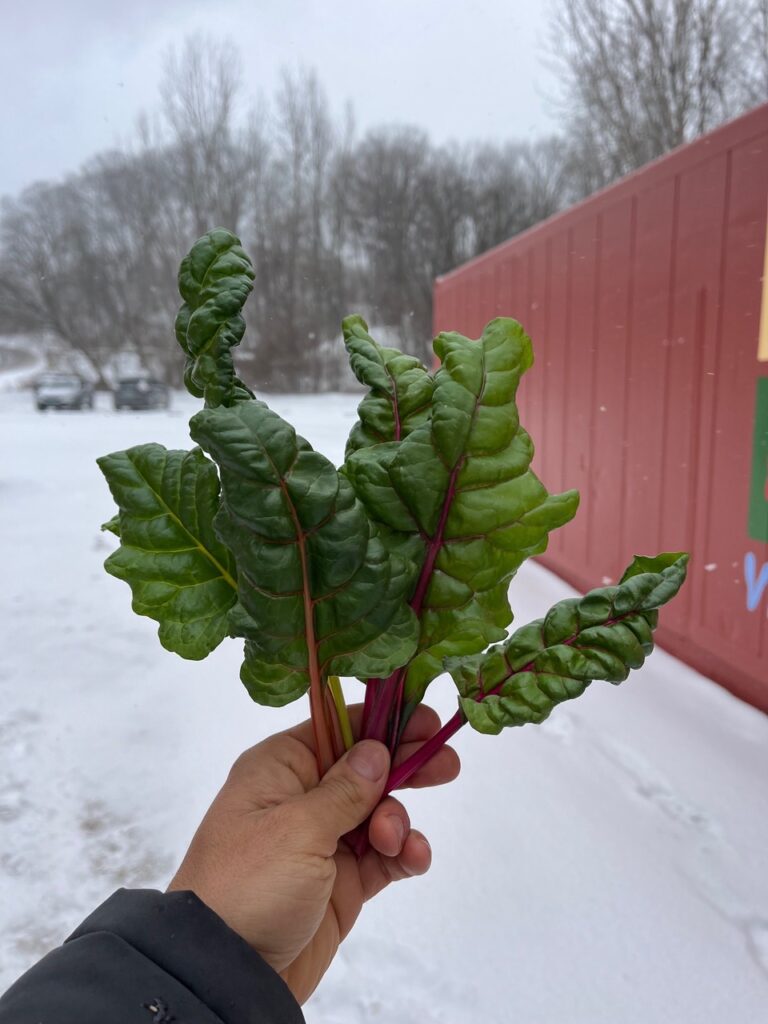
In Burlington, Vermont, the city is white with snow. The cold bites. But in a shipping container near the Winooski River, rows of bright, leafy greens are growing fast. The climate outside is one thing – the climate in here is another.
How do you grow leafy greens, in the middle of winter, fifty miles from Canada? The answer is inside, where the climate can be controlled, in a nutrient solution rather than soil: hydroponics. These plants are grown by the nonprofit Village Hydroponics. They’re freely distributed to Burlington’s underserved, often immigrant communities, many of whom can’t afford fresh, local produce, especially this time of year. Most are culturally important greens, harder to find at American supermarkets.
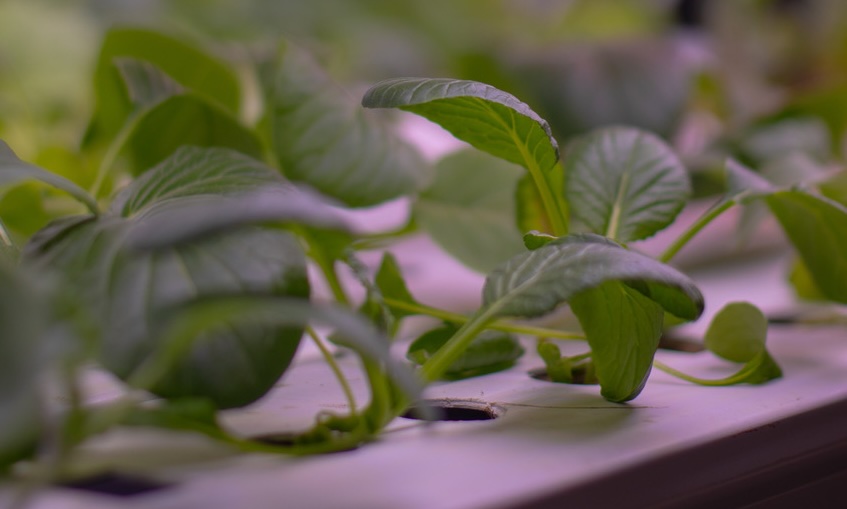
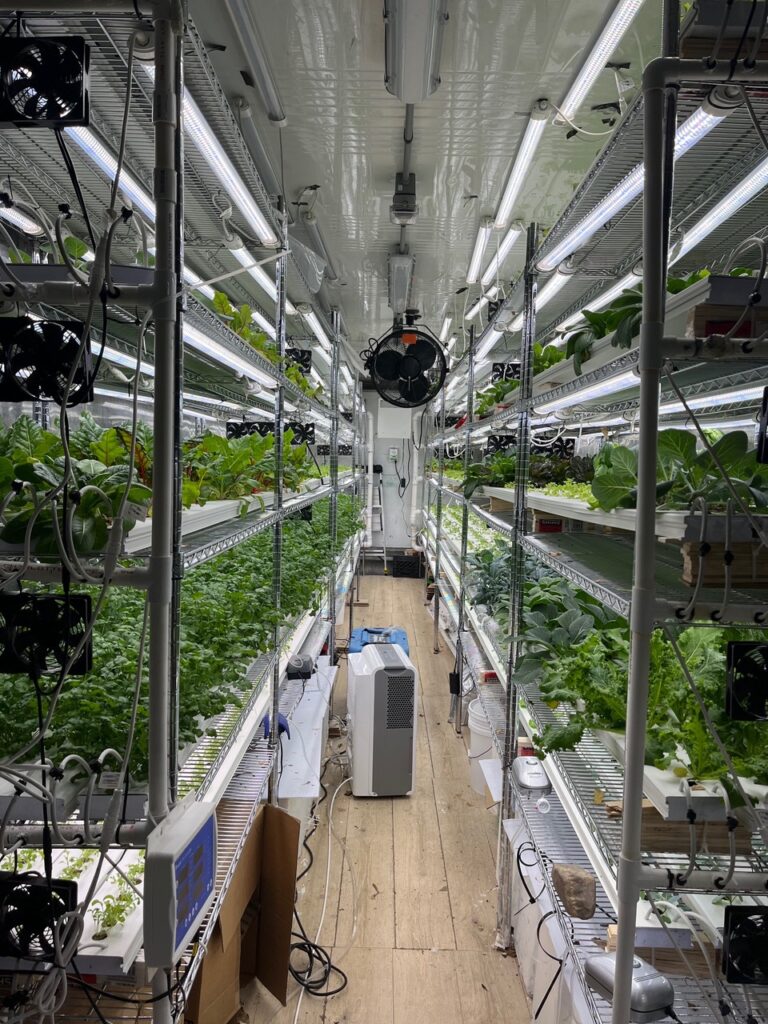
The shipping container is full with tiers of trays, where throughout winter, plants grow in one-inch foam cubes. All day, a pump circulates nutrients to the plants’ roots, and a monitoring system automatically adjusts their nutrient levels and pH. There are grow-lights on timers, and dehumidifiers and fans to stop mold growth and regulate temperature. The plants are on a seven-week seed-to-harvest cycle. Then, they’re distributed in an old truck with a certain charm and the number plate VEG MBL.
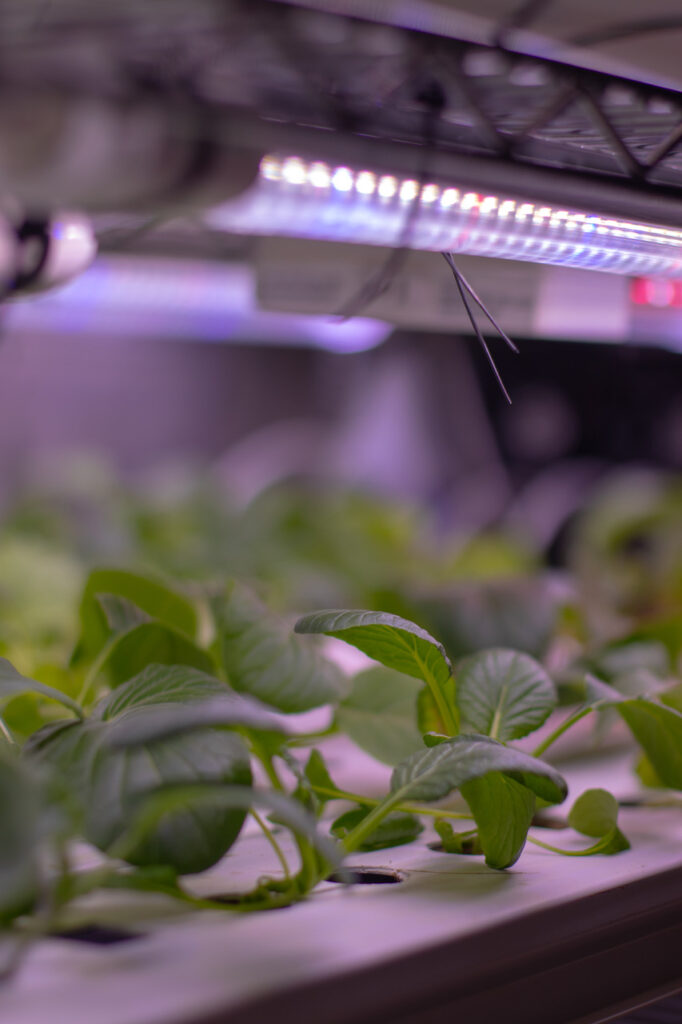
In the late-2010s, hydroponics had a moment in the limelight of the climate-stage. The soil-free cultivation method caught the AgTech wave, with several high-profile investments launching startups in Northern California.
Emerging as a climate-forward technology: hydroponic systems use up to 95% less water than traditional agriculture, and when it’s clean-energy-powered, the cuts to food waste and food miles can dramatically reduce crops’ carbon footprints. Furthermore, growing in this way builds resilience to climate challenges like extreme droughts and floods, soil degradation and rapid urbanisation. And by growing upward, not outward, hydroponics reduces land use, freeing up land for reforestation and other climate solutions, while reducing the need for harmful modifications, from pesticides to preservatives. Hydroponic crops also grow faster and generate higher yields—in 2016, the average yield for traditionally-grown tomatoes was 0.84kg per square foot; for hydroponic tomatoes, it was 4.8kg.
In Silicon Valley, there was talk of hydroponics revolutionising food and climate systems. A reputation followed—tech bros and their investors were applying techno-utopian, high-growth-high-returns thinking to vegetables—leading to growing skepticism in the global agricultural community.
Then the image started to shatter. In 2024-25, a series of hydroponic companies, including Freight Farms, Bowery Farming, and UK-based Jones Food Company, declared bankruptcy. The Bezos-backed company Plenty, apparently, gave off a Theranos vibe. After securing $1 billion from investors since 2017, the project managed to create one strawberry farm before going bankrupt in March 2025.
The problem was that hydroponics is difficult to scale. Upfront and operating costs are so high that in the world of industrial agriculture, it’s often not commercially viable. And the “climate solution” label can be misleading.
Back in Vermont, Village Hydroponics’ founder, Nour El-Naboulsi, agrees. For his shipping container, setup costs were around $85,000 (funded by state and local grants). The electrical bill is $1,000-1,500 a month. And from a climate perspective, the energy source matters. Village Hydroponics, is powered by Burlington’s McNeil biomass plant. The plant made Burlington the first 100% renewable electricity city in the US, but it’s controversial — it’s also Vermont’s largest single source of carbon emissions.
“It’s not as easy as: hydroponics is the climate-smart agriculture solution,” Nour says. “We need to be transparent, to think critically. In summer, when the sun and soil can do their job, Village Hydroponics isn’t running. We don’t need to. And if I was in a city powered by fossil fuels, I wouldn’t have the conscience to do this.”
“It’s not as easy as: hydroponics is the climate-smart agriculture solution… we need to be transparent, to think critically.”
On climate, then, hydroponics is not a silver bullet – but it’s not a false hope, either. As always, there’s nuance. But perhaps that’s the point. Perhaps we’re so used to seeing the big picture – a whole planet wrought by food insecurity and environmental crises – we forget that it can help to be myopic. Nour, for example, just founded Village Hydroponics to feed his community.
It’s not what venture capitalists had in mind, but this seems to be where hydroponics shines – through local, decentralised, community-organised projects. Real people, on the ground, in certain contexts. In contexts where droughts hit hard, but there’s abundant sunlight (hydroponic farms can be solar-powered, or built in greenhouses). In places where extreme storms cause flooding, destroying crops. In places like Vermont, where healthy food isn’t always accessible (and, where traditional farmers are struggling, hydroponics can offer an off-season revenue stream). And in cities, from London to New York, where food injustice is rife, and tools for climate action, resilience, and connectedness to food are not.
“I was a city kid,” Nour says. He’s from Brooklyn, falling in love with farming against the odds. His life here, he laughs, is a mystery to his family. “My dad is from Beirut, a huge city. My mom, New Jersey. But my dream is to build hydroponic towers for kids back in Brooklyn, and see them excited about growing their own food.”
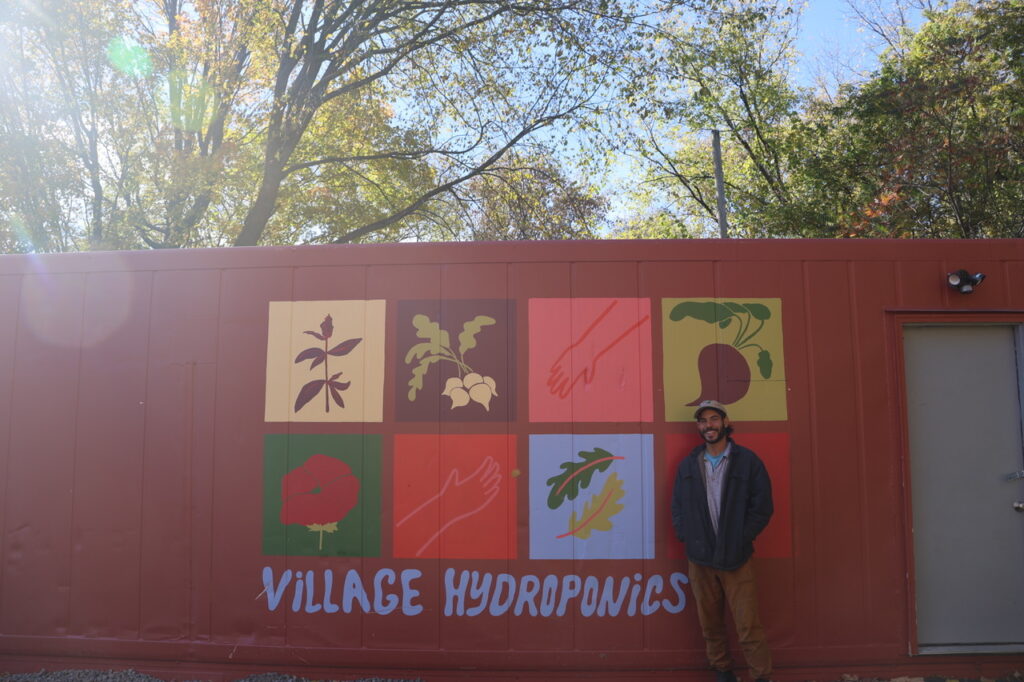
“I was a city kind… My dream is to build hydroponic towers for kids back in Brooklyn, and see them excited about growing their own food.”
This, perhaps, is hydroponics’ secret weapon. By 2050, 68% of the global population will live in cities – many of us increasingly alienated from our food, and the broken systems that produce it. Governments aren’t fixing these systems fast enough. Through hydroponics, urban communities can start to take back ownership.
Organisations are seeing that. New York Sun Works, for example, is a nonprofit that’s installed hydroponic systems in over 350 New York City schools – reaching 140,000 students annually. It focusses on bringing its programming to under-resourced communities, with 72% of students’ families below the poverty line.
Through hydroponics, growing seasons can fit the school calendar, and are possible in neighbourhoods with limited access to nature; Chinatown, South Bronx, and Brownsville, Brooklyn. And they’re a tool, a hands-on, edible gateway to learning about not only climate action but also environmental and food justice. Through this, young people are taught to think systemically about the connections between the agricultural systems that keep Bronx kids fueled by junk food and those driving deforestation, toxic runoff, and poor public health halfway across the world.
Megan Nordgrén, Director of Development and Government Relations at NY Sun Works, says there’s huge demand for curriculums like theirs. “Students want to learn about climate. Students, and teachers, want to have skills that are relevant, that meet the moment and make them climate-resilient. We show them that they have agency – that even in a tiny apartment, they can grow something fresh. That students of colour can have farming careers, which is rare in New York State. And we’re encouraging students to take civic action — to write to their officials, and invite them in for conversations.”
Projects like these work best when they complement city policy. In New York, policy increasingly combines climate resilience with energy and housing affordability, public health and environmental justice goals. And further afield, cities are establishing policies that more actively include food systems in climate plans, provide land access for growing food, treat schools as climate-food learning hubs, and partner with nonprofits and communities to roll this out.
In low-income Parisian neighbourhoods, for example, the Paris Climate Action Plan envisions schoolyards as flood- and heatwave-resilient “oasises” – sites of climate and civic education and refuge for their communities. The Parisculteurs program, meanwhile, leases public land and rooftops to food cooperatives and nonprofits, and provides funding and technical support for food and climate education. In Canada, Toronto’s TransformTO climate plan offers grants and land access for community gardens and urban agriculture. Other cities are following suit. With local governments as partners, hydroponics initiatives grow faster and healthier.
By bringing people into the food system, we might start to redefine it.
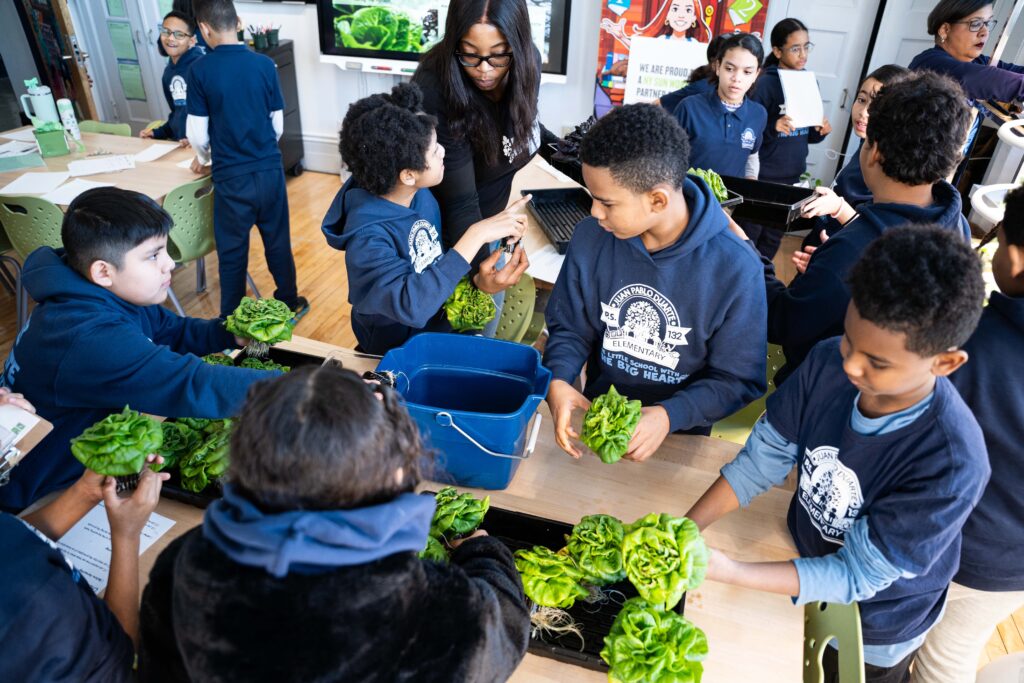
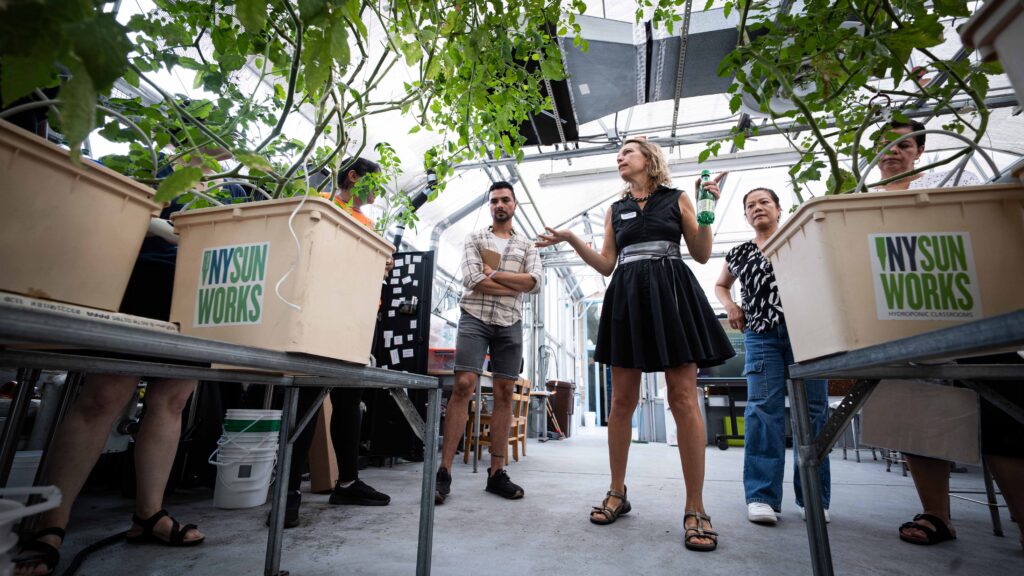
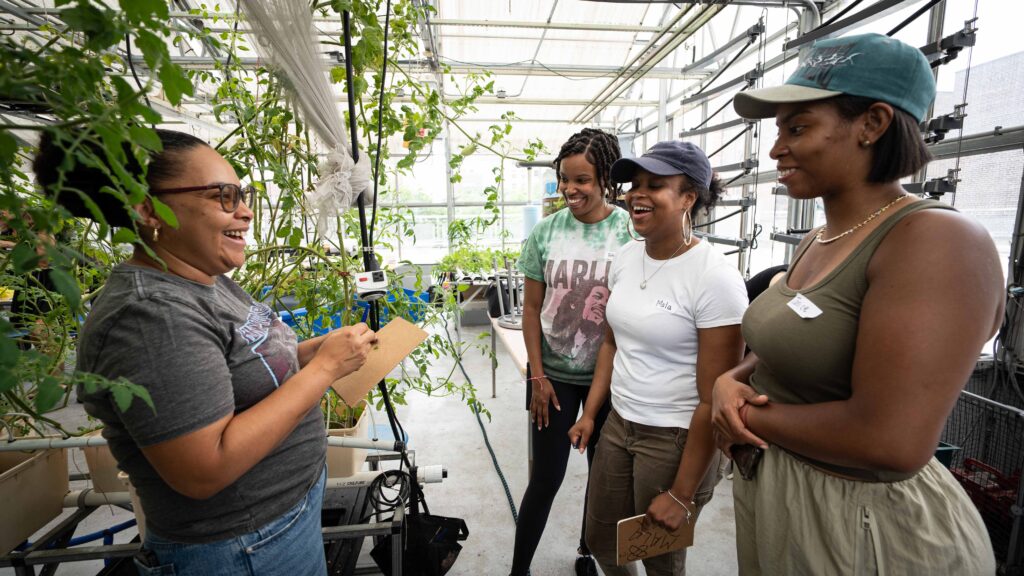
Hydroponics can be a means of slowly redistributing power. By bringing people into the food system, we might start to redefine it. And it starts with the plants themselves.
Growing plants in highly artificial settings, with no soil and sometimes no sunlight, may not seem like an obvious way to reconnect to nature. But it works. “Students’ reactions,” Megan says, “are wonder, excitement, joy. They build strong connections to food as a living plant, and they’re tremendously proud of what they grow. It’s beautiful.”
Nour echoes this, his smile lighting up in the cold air. “In winter, we come down, and we get to see these living things and take care of them. We’ve had school groups come too, and they love it.”
“Student’s reactions are wonder, excitement, joy. They build strong connections to food as a living plant, and they’re tremendously proud of what they grow.”
Love and care — for community, for nature, for the eternal miracle of a shoot growing out of a seed, and the kid who puts it on her plate — are strategically important to the climate movement. Love for future generations is the strongest motivator for climate action. And globally, at least 56% of people think about climate change daily or weekly, but far fewer know how to act. Community-centered initiatives like Village Hydroponics and NY Sun Works, using solutions like hydroponics, invite people into this work – and root our connection back into the food we eat, and the systems that we depend on.
“When people ask why we’re doing this,” Nour says, “we don’t just want to say, because we love our community. We want to say, because our system is broken. We have to look out for each other, because our governments are not prioritising the world that we want. We want to live in a system where your income has nothing to do with the level of nutritional access you have, or what you can do for the planet.”
To design a global tapestry of climate solutions, we need to think in patchwork terms – local contexts, tailored solutions, woven together. Large-scale, capital-intensive solutions are important too – and often, small-scale initiatives require funding from big institutions. But in the end, climate and nature are complex, interconnected systems. Climate solutions should be, too. They should be adaptable, agile, resilient to political and economic turbulence. Some should start local, empowering communities, while laying the groundwork for collective climate action. That, perhaps, is hydroponics’ secret power: it’s sewing the seeds for systems change, one one-inch foam cube at a time.