To regenerate a place, you must also bring back the people: community-led practices like surfing enable return, healing, and stewardship.

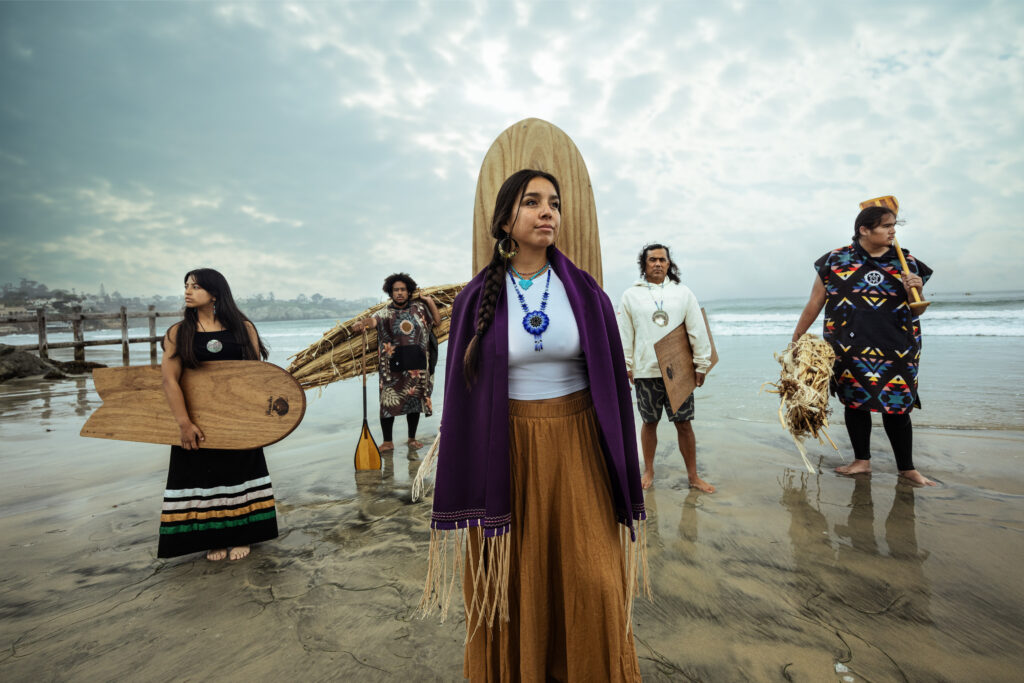
As founder of Native Like Water, an Indigenous youth organization reconnecting young people with nature, cultural knowledge, and community, educator, advocate, and surfer Marc Chavez is looking beyond our current Western ideas of regeneration of bringing native species back, and what it means to bring the people back to the Land.
Born in Los Angeles of Nahua, Michoacán, and New Mexican-Spanish descent, Marc grew up far from the coast, the ocean always unfamiliar, foreign. Marc’s early education spanned both private and public schools. After being disillusioned with the education system and dropping out of high school for a time, Marc found himself out on the streets, which he described as a “rough” but transformative experience — one that would give him insight into the issues young people, especially teenagers face, and eventually lead him to his work of over 25 years.
In our conversation, we explore Native Like Water and its vision of reconnection to ancestral lands—how time in the ocean, especially through surfing, can become a pathway to healing, regeneration, and getting back in tune with nature. Marc speaks about the importance of rebuilding relationships with nature, particularly for Indigenous communities, where regeneration is closely tied to cultural identity and where environmental justice is social justice. Surfing, he explains, is more than a sport—it’s a form of cultural practice and environmental stewardship, a way to reconnect with Indigenous knowledge, strengthen community, and renew the bond between people and the natural world.
Lukas Brunner: Tell me about Native Like Water (NLW). What do you do?
Marc Chavez: Native Like Water empowers, educates, and connects Indigenous youth with nature—especially with ocean and freshwater land environments. Through our programs, we get youth engaged in environmental studies and science, in cultural studies, in technology, in health, and in self-sustainability. We approach education in a holistic way, tapping into both Western science and Indigenous knowledge—we call it indigenizing education.
We connect with various Native American tribes throughout California, Hawaiʻi and other parts of the United States, and even internationally with Jamaica, Mexico, and Panama, to name a few countries, through our InterTribal Youth program.
Because of my own experiences as a teenager, I feel I can better understand the needs of the Indigenous youth. One of the biggest issues is mental health—realizing you shouldn’t walk around feeling guilty, feeling like it’s your fault if you didn’t do well in school, or if school didn’t “touch” you in the way it’s supposed to.
The idea of this program is for young people to understand that it’s not their fault, and instead to find something they can relate to, something that excites them and makes them want to learn.
With less than 1% of the Native American population going on to university, that leaves roughly 99% of folks out there who need something meaningful to get involved in. That says a lot about where our population stands. That is why we’ve expanded and included young adults as well—because “adulting” after 18 can be a big struggle.
LB: Can you tell me a bit more about why reconnecting with nature, and specifically the ocean, is such an integral and important part of your work?
MC: Let me start with the bigger picture and historical context. In my area, in San Diego and Southern California, access to the ocean is not very common. You have extremely high real estate costs along the coast, with wealthy coastal property owners, many of whom are not native to that area.
In San Diego, Native American communities were removed from their natural habitat for one to two hundred years—that’s three or four generations disconnected from our natural habitat and cultural practice. That’s a very important piece for me personally and for the work we are doing. They were displaced and now live an hour or two away from the coast. That has disconnected the people from nature and severely disturbed an ecosystem that once existed in harmony.
Ecologically speaking, when you introduce an invasive species into an environment, it creates an imbalance—sometimes a detrimental one. If you plant invasive plants or weeds, they’ll choke out the Indigenous species—both flora and fauna—which negatively affects the whole ecosystem. For me, the big issue was seeing the decline in the mental and physical health of our people—the health of our Native American community—and how that connects to returning to the coastal environment.
I don’t mean to equate humans with animals, but I do want to equate the importance of natural habitat for us as humans. It’s important to reconsider our human place within these environments.
Now, in the last 25 years, I can’t say we’ve been able to purchase coastal property—though that would be amazing, maybe even a “pipe dream”—but what we have been able to do is start a program that brings young people back to the coast, back to where their ancestors used to live. There, they can recreate, learn, and simply show up and be present. I believe that nature, and the ocean specifically, is integral in the process of making our communities and our environment healthy again.
LB: What you’ve mentioned about the importance of natural habitat for us as humans is something that you don’t hear as much in the context of conservation. Can you elaborate a bit more on that and its importance in your work?
MC: Absolutely! Ecologically, you call it regeneration—when you rehabilitate things back to their normal and natural state. Environmental justice and social justice, for me—or for Indigenous Peoples—are one and the same. We need to bring back not only the native plants and animals but also the people who once lived there. That part often gets lost in environmental advocacy—because most people only think about plants and animals. Rarely do you hear anyone say, “Let’s bring the original people back.”
If you’re truly regenerating a place, and if you’re trying to return it to its natural state, you also have to restore the human dynamics that belongs there. That’s part of social justice.
A lot of what’s happening now—the issues our communities have—comes from a lack of space. I had the privilege of spending time with Dr. Jane Goodall, and one of the things she shared was that apes became violent when their space was reduced—simply because of that lack of space. And that’s really what creates many of our current issues.
Real regeneration is super important. For us, it’s about survival. Our communities are close to being extinct. You can see that reflected in our population numbers, mortality rates, and all the social issues—alcoholism, domestic violence, bad nutrition, and so on.
While very few current landowners are actually trying to give land back, at the very least, we should have a full discussion about what’s best for the environment—which must include not just restoring flora and fauna, but people as well.
We have been working on this for the past 25 years. It takes time before you start seeing true regeneration. Now we have adults who were teenagers in our program and are in their 30s today, with kids of their own. They’re bringing their youth back to the beach, back to our programs—and that’s when you really see regeneration happening.
If you’re truly regenerating a place, and if you’re trying to return it to its natural state, you also have to restore the human dynamic that belongs there. That’s part of social justice.
LB: What role does surfing and spending time out in the water play in NLW’s program and in regeneration?
MC: Focusing on something as cool as surfing helps a lot in the work we do. It is super attractive and super functional. It’s fun, and it works fast. It’s a solution to so many issues our communities face.
Surfing has a strong physical and mental wellness function—you have to be committed, you have to be in the moment, you can get into the flow state within seconds, and it also connects you directly to the environment. It can be a portal into a specific kind of thinking and observing nature.
Today the water might be nice and clean; tomorrow it might be polluted after a rainfall. Right now it could be windy, and three hours later the wind could stop. We’re constantly paying attention to weather changes, environmental changes, and fluctuations in water and air quality. And those changes are not just local—they’re global. The swells aren’t generated locally; they’re created thousands of miles away. The airstreams and currents that affect us are traveling across oceans.
There’s this trans-oceanic connection that you only notice if you’re watching closely. Most people never even think about it, but because we’re out there constantly observing, we see the changes.
I have friends who are environmentalists but don’t surf. Unless they’re scientists, they’re not observing the natural patterns the way we surfers do. They might not know that we currently have four tropical systems forming—they might vaguely feel the weather change, but we’re watching maps all the time.
In my opinion, surfing connects you to that larger space—to the bigger conversation of global climate change and how we’re all connected. Surfing makes you a kind of global citizen. Not all surfers are environmentally conscious, but it still places you in direct relationship with the natural world. You’re constantly monitoring, constantly one with what’s happening around you—more than most people I know.
Surfing brings a lot of parallels to an Indigenous way of life—because it’s, in a way, how our ancestors lived.

LB: So surfing can be, in a way, a tool to regenerate and reconnect to an Indigenous way of life?
MC: That’s right. Aside from being out in the water almost every day, surfers are constantly studying live satellite maps, forecasts, and data. But in the past, people read signs in the sky, in the winds, or in bird movements before weather systems arrived. They could read nature in that way.
What’s important about all that is how it reconnects us to a style of living where you’re once again tuned in to the heartbeat of what’s happening naturally. It not only means being physically active and supporting mental health—it is also spiritual. It connects you to the unseen—the energy you can’t explain but feel. Surfing allows for that in a way that few other things do—you move with the rhythm of the sea. Surfing—riding a wave back to shore—itself is Indigenous.
There are so many layers to what we’re doing with NLW and the role surfing plays in it. It’s not just, “Hey, everyone come to the beach and go surfing.” That happens too—but for many, especially elders, it’s deeper. A lot of them are scared, and they don’t even know why they’re scared. They just are.
A lot of people in Indigenous and Black communities carry trauma connected to the ocean and to water. During times of genocide, colonisation, and Western expansion, families were murdered, and many tried to escape by running to the water—only to drown or be killed there. That memory has been passed down through generations—it’s an intergenerational memory.
So it’s about feeling comfortable again in an area we were removed from—where the last time your ancestors were there, they were being slaughtered or massacred. It’s about releasing trauma. And surfing plays a big role in that process.
[Surfing] connects you to the unseen—the energy you can’t explain but feel.
LB: There is a broader and growing understanding of surfing—not just as a recreational activity or sport, but also, and first and foremost, as a cultural practice. What are your thoughts on that?
MC: Yeah, that’s a huge statement—and one that many of us are promoting. I started to really hear it more and push it when I was in Hawaiʻi, where people were saying clearly that surfing is a cultural practice, not just a sport.
First of all, surfing today is a billion-dollar industry—literally called the “surf industry.” And then there’s also what people call “surf culture.” Like with many things, you start to wonder what that means when it comes to culture. There are people who didn’t invent the culture but still claim it as their own.
Surfing dates back hundreds—even thousands—of years for Indigenous Peoples, especially those living in tropical regions where the ocean was part of daily life. It clearly originated in Indigenous environments—environments of darker-skinned peoples. So to see the modern surf industry and surf culture now represented mostly by Anglo or European faces—by white people—can be misleading in an educational sense.
For us as Indigenous Peoples, it can make us feel like surfing isn’t ours, like it doesn’t belong to us. Even now, I’d say 80–90% of people still believe that surfing is “not something we do.” When I was growing up and started surfing, I’d hear that all the time: “Why are you trying to be white?” In the States, that’s what people would say, because only white people surfed. You hardly saw brown people surfing in California. Hawaiʻi was different, but still, surfing was seen as something reserved for those privileged enough to live by the coast. That misled us—made us feel we shouldn’t surf, or even feel guilty for doing something we “weren’t supposed to do.”
Take San Diego, for example. The factual data shows Indigenous presence there for over 20,000 years. Carbon dating has its limits, but still—20,000 years is a long time. Compare that to this 500-year colonial period of European history—it’s tiny. So it just makes sense that our ancestors were surfing long before colonization.
If you’ve ever been in a coastal community, you know that fishermen take waves back to shore after fishing. The organized idea of surfing came later, when people started defining it as a sport. But as a cultural practice, it’s as old as fishing—just as important and just as ancient.
Everywhere I’ve traveled—back in the day, in the ’80s and ’90s—even in places where surfing didn’t exist, I saw kids surfing on pieces of wood. It’s very common. Some regions have deeper documentation than others, but the practice itself is universal. We might not know exactly what surfing looked like a thousand years ago—though in some places, like Peru, we have clues.


LB: The Pacific is a global leader in marine protection, with some of the largest marine protected areas (MPAs) located in the region.
Indigenous communities have long been active stewards of the Pacific’s coastlines and nearshore waters—both historically and today. In recent years, there have been several strong Indigenous-led conservation efforts, leading to one of the first marine sanctuaries led and managed by Indigenous communities—the Chumash Marine Sanctuary—as well as the recent success story of the dam removals on the Klamath River.
I’m curious to hear your thoughts on the topic of MPA’s and the importance of integrating Indigenous voices and practices into future conservation work, and in establishing Indigenous-led and managed sanctuaries.
MC: Right, those sanctuaries and MPAs are very important and significant achievements. However, I really want to stress the importance of integrating Indigenous voices into the planning and management of future MPAs.
Recent MPAs created around San Diego were established without Indigenous community input, which is problematic. The dominant conversation doesn’t always seem to include the Indigenous perspective or allow for the practice of Indigenous ways.
It’s easier said than done to integrate what we call traditional ecological practice or knowledge. That requires real integration—real, intimate exchange in these water environments—which sometimes the communities aren’t ready for. We need programs that help train people to dive, fish, and engage in all these practices again—things they’ve been removed from. That’s an important piece, and it has to be allowed for.
To give an example of what I mean, where I live in Mexico, along what they call the Nahuatl coast, people have fished for thousands of years—using traditional traps and harvesting methods that existed in harmony with nature. Sea turtles were once abundant, like the buffalo on the plains—a vital, sustainable food source and an animal with high spiritual and medicinal value. The decline began with European and North American poachers seeking turtle oil, meat, and shells, and nowadays, with overfishing and commercial exploitation. I want to make that point because criminalising that practice severed a cultural tradition that was sustainable for thousands of years. And then what happened? People were introduced to cows—especially in tropical areas—and began cutting down forests for cow pastures. Cows need so much acreage to survive. It just shows that before Western or coloniser influence, people lived in harmony with nature, without exploiting it. That’s just not the reality anymore.
Looking forward, I think co-management is the future.
In a co-management situation, you have much more access to the land, whereas before you had to ask for permission from the government or state park to enter, recreate, or hold traditional ceremonies.
Let’s say you have a state park, a national park, or even a military base—something the U.S. government runs. Usually, or most of the time—about 80% of the time—you’re going to have a tribe that was living there before. Remember, all of these national and state parks that the government controls were once the most precious lands—the lands where those Native villages were.
In many of these places, if you visit them, they’ll have only a very small mention of Native people. They might not have any Native people working as what they call docents in these areas. You’re also seeing that the government has not been able to keep up with those areas and spaces. There are a lot of financial strains and issues, especially in California. These are great opportunities for partnerships that include Native communities in helping to co-manage these places. What co-management really fulfills is the idea of ownership without it being ownership. Because there is a problem: we don’t have enough resources in our community to go and say, “Yeah, I want to take this back.” There’s a lot involved—to buy it and maintain it.
A great example of successful Indigenous integration is the recent co-stewardship of a piece of land in Northern California between the Yurok Tribe, the nonprofit Save the Redwoods League, and the National Park Service. Rosie Clayburn, one of my former students and a leader of this initiative, was able to bring her whole community together—which can get politically tough, as “community” can mean several tribes within one group. The Yurok were also advocating for the dam removals on the Klamath River you mentioned.
I’m using state parks and national parks as the primary example because they include the majority of the land where people go to recreate. But the same applies to the coast as well. In a co-management situation, you have much more access to the land, whereas before you had to ask for permission from the government or state park to enter, recreate, or hold traditional ceremonies. You’re seen as almost an equal in managing these natural areas.

LB: So you envision a future that weaves together the reality of our current systems of governance and Indigenous wisdom?
MC: It’s important to include Indigenous Peoples because they have a different perspective. The Western side is the dominant power all around—not just in conservation—so we need to include the Indigenous perspective in order for everyone to move in the right direction. And that’s what we do with Native Like Water.
We’re not just Indigenous—we’re both sides. We’re Western and we’re Indigenous. We need both perspectives to come together for the best of everything.