As corporate and political powers converge amid climate and inequality crises, an organiser makes the case for scaling people power.
Maren Costa is a climate justice leader, tech worker organiser, and speaker focused on corporate power, labour rights, and environmental accountability. After more than a decade as a senior User Experience leader in big tech, she co-founded Amazon Employees for Climate Justice and publicly challenged Amazon’s climate and workplace policies. Her organising drew national attention, and she was later fired amid disputes over internal activism during Covid-19.
Her experience helped spark a broader effort to unite tech workers, warehouse staff, and the public around shared climate and labour demands. Costa now advises and trains organisers, speaks on building worker power inside corporations, and contributes to public conversations on corporate accountability and climate action. In this wide-ranging discussion, Linda Förster of Icarus Complex speaks with Costa about organising within tech, the limits of corporate innovation narratives, and the role of sustained, nonviolent action in driving climate solutions.
Linda Förster: Can you share how your career path and time at Amazon led you to climate activism? What was the moment when you decided that polite proposals weren’t enough?
Maren Costa: Finding climate action at Amazon wasn’t hard, because Amazon was a poster child for what not to do on climate. The turning point came at a happy hour when a friend asked, “How can you still work there?” I realised I needed to act. There was this myth that e-commerce was greener than brick-and-mortar retail. Some people at Amazon still believe that—it’s not true. Consumption exploded, and no one wanted to see it. I remember a recruiting event where someone asked, “What is Amazon doing about climate?” I had no good answer. The story we’d told ourselves, that online shopping was better, had stopped being true.
Then I had kids, and that made it personal. Their future didn’t look good, and I couldn’t just talk or pitch ideas anymore – I had to take a risk. I’d proposed so many projects that went nowhere, because at Amazon every idea had to answer two questions: How does it benefit customers? How does it benefit the business?
Climate action did both, but in ways customers weren’t yet demanding, and those profits wouldn’t show up next quarter. Leadership always found a reason to stall. “If we lose money, we’ll have to fire warehouse workers.” “If we don’t do it, China will, and it’ll be worse.” There’s always a way to justify doing nothing. But if everything is about what benefits customers, then the real answer is obvious; what benefits customers most is a livable planet.
“If everything is about what benefits customers, then the real answer is obvious; what benefits customers most is a livable planet.”
LF: Amazon has more than 1.5 million employees worldwide. What does it actually look like to organise from within a company of that size?
MC: It’s hard and still is. Harder now, because people feel like they have targets on their backs. When we co-founded this movement, we knew we were taking huge risks. We tried to delay the inevitable—losing our jobs—but eventually they fired us. At first, though, we made it as complicated for Amazon as we could. They had to ask themselves: “How do we get rid of these people without losing in court?” Eventually, they decided it was easier to take the hit and get sued by the NLRB and settle, than let us keep organising… Organising itself is hard work.
We had mentors from real labor unions who trained us, and then we trained others. We taught them how to build trust, how to get people to show up, and to take risks at their own pace. It’s a skill; there’s a real science behind it. One of the first lessons was that divide and conquer is rule number one of power. And Amazon had mastered it. When I started, there wasn’t this divide between warehouse and corporate, because we were one team. At Christmas, even Jeff Bezos and engineers went to Fernley, Nevada, to pack boxes. Over time, that unity disappeared. Two Amazons emerged. So when we did the most forbidden thing by bringing warehouse and corporate workers together. It terrified corporate leadership. During COVID, warehouse workers were saying conditions were bad while Amazon insisted everything was fine. We proposed a town hall so they could talk directly to each other.
That simple idea of connection was enough to scare executives, because they knew that our biggest strength was the one thing they feared most—unity.
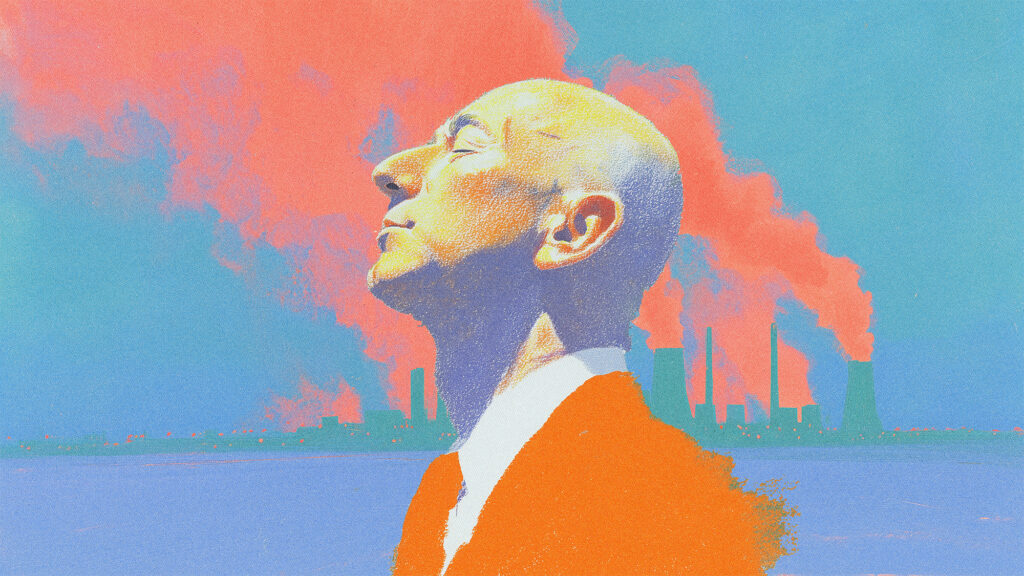
LF: In 2019, over 8,700 Amazon employees signed an open climate letter, and hundreds later joined walkouts and virtual town halls. Looking back, which tactics created the most momentum, and why?
MC: Back then, people weren’t as afraid. What drove them was frustration and shame. Amazon had no climate plan and was lagging far behind its peers. I remember seeing the company get an “F” on every environmental scorecard. For a company obsessed with being first, that was shocking. Jeff’s motto was always “It’s still Day One.” So in our open letter, our message to him was:“This is so Day Two, Jeff.” That hit a nerve. For Bezos, it was ego. Power always has an emotional vulnerability, and you can use that. Tech companies hide behind this myth of American innovation.
Innovation has become a kind of religion. If you question it, you’re labeled anti-innovation. But innovation inside a broken system only amplifies the damage that system perpetrates. If profit comes before people and the planet, then technology just accelerates destruction, and that ties directly to inequality.
“Innovation inside a broken system only amplifies the damage that system perpetrates.”
LF: The richest 1% produce as much carbon emissions as the poorest 66%, and they exhaust their yearly carbon budget in just 10 days, while the poorest take nearly three years to do the same. How does this stark carbon inequality influence your messaging to both Amazon leadership and employee allies?
MC: Really, it’s the top 0.01%. That’s a few hundred people: the Elons, the Bezoses. Their wealth grows on autopilot, and it’s completely detached from reality. People say, “I know a millionaire who’s a good person,” but we’re not talking about that. No one needs $400 billion, and that level of wealth automatically buys political power. That’s the danger. The “evil trifecta”: Big Oil, Big Tech, and government. Their interests have merged. That’s why there’s such urgency now. We’re facing record inequality, biodiversity collapse, and climate breakdown. We’ve breached seven of nine planetary boundaries. A handful of ultra-rich people are deciding the fate of the atmosphere, and the only real counterforce we have is people power: organised, strategic, nonviolent action, work stoppages, strikes, civil rights marches.
We’ve organised nationally and within companies; we just haven’t scaled it up to the global level. That’s my message now: keep fighting local battles, but think globally. Because while you’re saving one river, twelve more are dying. You can win one policy while twelve worse ones get written. Every new administration resets progress, and if the U.S. fails, the world feels it.
Division has made us powerless, and that’s how power wins by keeping us divided. We have to face that division on the grassroots level: Meeting people where they are. We need to rally around our commonalities, and have one flag, and one focus. Humans respond to stories with a good guy and a bad guy. We can’t get mad at pollution. We need to point upstream. Who’s putting it there? We need to name villains. We all want clean air, safe water, safety for our children, meaningful work, and enough to live well. That’s universal. So the message is, if you have a beating heart and want to live, come this way. We’ll figure out the rest later.
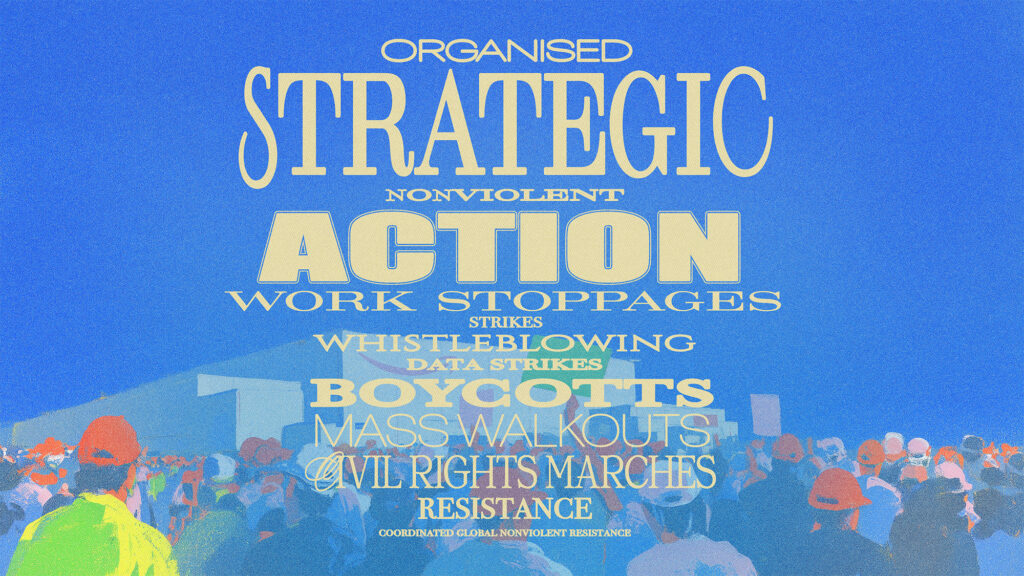
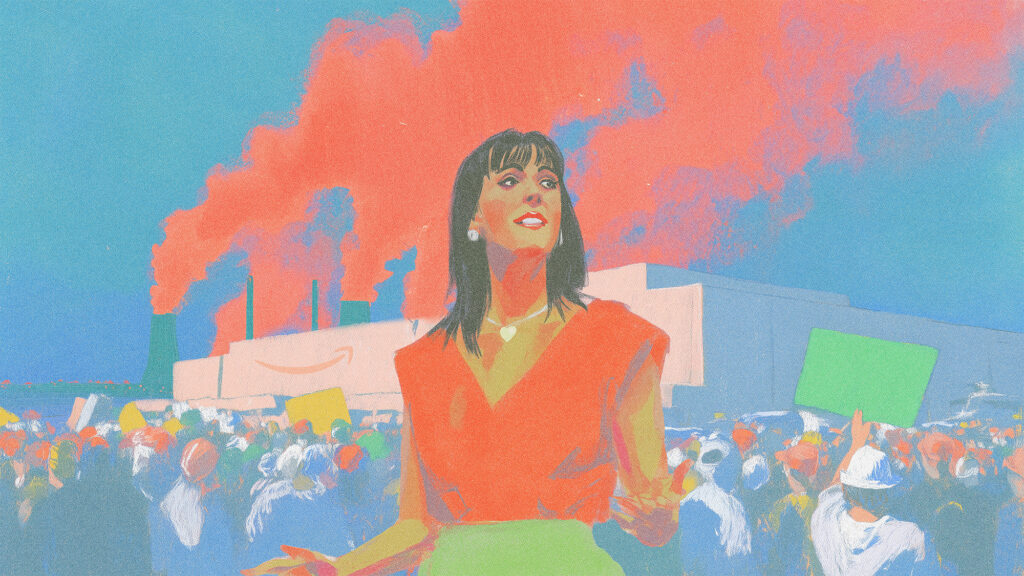
A handful of ultra-rich people are deciding the fate of the atmosphere, and the only real counterforce we have is people power: organised, strategic, nonviolent action, work stoppages, strikes, civil rights marches.
LF: Employers often use internal policies or surveillance to chill organising. How did Amazon use policy and process to push back, and how can organisers plan for that?
MC: It’s incredibly hard. After Amazon, I organised at Microsoft, then Google. Fear has spiked massively over the years, and it’s hard to get people to act. But one tactic is to lead people through the logic of risk. Sure, it feels safer to stay quiet, but what happens if we do nothing? You help them see they’re not safe either way. It all moves at the speed of trust. You have to build that first, because we like to think we’re rational, but 95% of our decisions are emotional, based on trust and vibes.
LF: What is one thing you wish more people understood about grassroots organising, especially in the climate movement?
MC: That you can learn it. It’s a skill. Go join a grassroots movement in your community—climate, housing, voting—it doesn’t matter. It’s all connected. There are methods, strategies, and training that make it less intimidating. But you have to get in the game. What gives me hope is exactly what I’m describing here. A global, sustained, strategic, nonviolent movement. It’s absolutely possible. We know how to do it. There are people everywhere who get it. We have way more than the 3.5% tipping point that Harvard’s Erica Chenoweth identified. Her research looked at movements around the world and found that when just 3.5% of the population engages in active, sustained nonviolent resistance, real systemic change becomes inevitable. Governments fall. Laws shift. Entire societies realign. We’re already beyond that number in terms of people who care deeply about climate and justice. What’s missing is connection. We need to link the groups, organise the organisers, and be ready when the call comes. Everywhere, amazing people are doing amazing work. Nothing is stopping us except inaction.