Cristopher Rogel Blanquet is a documentary photographer and journalist whose work specialises on coverage of social conflict, torture, migration, human rights, vulnerable groups and natural disasters. He believes that photography is not only a powerful medium to tell other people’s stories, but a window to communicate what he sees through the eyes of others. He received the 2021 W. Eugene Smith Fund Grant and the POY Award of Excellence in the 2023 World Press Photo Contest for Beautiful Poison, a long-term photography project documenting the public health problem associated with the unrestricted use of agrochemicals by the flower industry in the region of Villa Guerrero, Mexico. This project documents the lives of four families in Villa Guerrero that have suffered the loss of a child, genetic disabilities, or chronic diseases related to agrochemicals. Icarus Complex’s Digital Producer, Madeleine Bazil, spoke to him about Beautiful Poison, building trust, and systemic storytelling.
Madeleine Bazil: Could you give a brief introduction to Beautiful Poison and how you began working on that story? How did you come into connection with the story?
Christopher Roguel Blanquet: Beautiful Poison is the principal work in my career, because with this work I have a lot of recognitions and grants. I think that I’m very lucky because I am a Mexican photographer with one job in a little town near Mexico City and at the beginning of this work, I never imagined the power of this work in the world, in the photography industry. I began this work because my family is from one town near Villa Guerrero. Villa Guerrero is the town where I work. My family is maybe 20 minutes away from Villa Guerrero. And I was born here in Mexico City. Every weekend I travel to this town to see my family. My family, my father, my cousin, and my aunts cultivate flowers too. Not on the level of Villagerrero, because Villagerrero is more industrial, and is a flowering industry. Cuapacstongo is the little village near Tlancingo – near Villagerrero – that is the town of my parents. I think that 70% or 80% of this village work in the flower industry, every day go to Villa Guerrero to work and after that come back. This region has a lot of flower activity for this reason.
My father told me one day when I was 8 years old, 9 years old, I don’t remember exactly, that maybe these people have medical problems because all the time they work under chemicals or whatever. Almost three decades after, when I decided to begin on environmental work, I remembered this information from my father, and began this work. I was documenting in the region for three, four years. Beautiful Poison is one documentary work about the malformations, congenital problems from the use of the agrochemicals or pesticides in the growth of flowers. I believe that this work is an aesthetic thing, it’s very poetic. I don’t say that. The people that see this work say that. But I think that this work has this result because I was born there. I know the context, I know the people, I know all the daily life of these people. And I think that for this reason I can slowly make this big project with a little poetry. Because maybe I don’t document my family, I document other families, but these families are very [similar] to my family, and I think that indirectly I document my family too.
MB: You’ve sort of already answered it, but this project deals with such a challenging topic and it’s so sensitively done. And so I was going to ask what your approach is with building relationships that are clearly very trust-based relationships. Otherwise you wouldn’t be able to make these really poetic, sensitive images, right? Is this because you feel, like what you’ve said, that you know this community so deeply that you’re able to access that kind of trust?
CRB: Yes, I think that I can make a very, very deep work because I know these people… In this moment, I don’t know Dona Petra, I don’t know Don Tino, but I know the dynamics in this region. When, for example, Dona Petra asked me: ‘Do you want to eat maguey?’ It’s like a cactus. I said: ‘Okay’. I love maguey because I’ve eaten this kind of food all my life. And these little details make me more intimate with these people – this is a little example, but when I accepted this food, Dona Petra told me, ‘I don’t imagine that you eat this because you come from the city and these people don’t eat that.’ No, no, no, I love this food. It gives me more trust, more confidence. And for this example, I have a lot because it’s a mirror of my family. I think that for me it’s easy and well… Now all my life has been in Mexico City, but one part of my life I live in a little town with less people. And for this reason when I work, not only in the beautiful places, when I work in earthquakes, in little villages in Mexico, in little villages in Ukraine, or whatever, I think that I have an easy way to connect because I know the context.
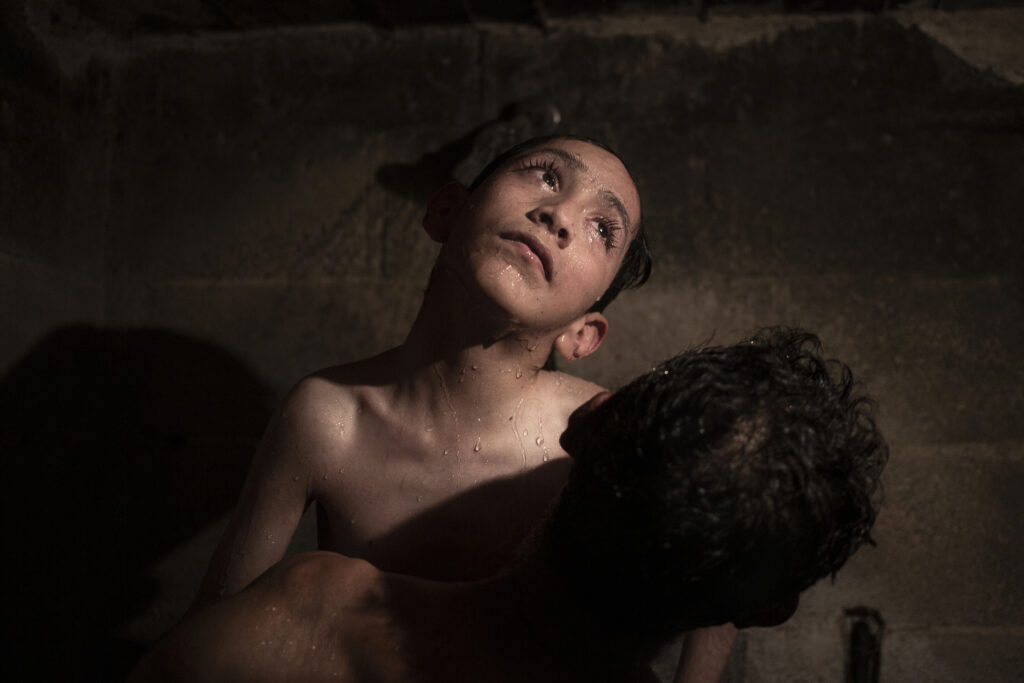
I took this photograph after having an established relationship with this family. Sebastian’s mother, Petra, welcomed me into their home, and liaised my connection to similarly health afflicted people in the flower-growing region of Villa Guerrero. She was the one who encouraged me to witness and register this bathing scene in order to understand what their daily life was like with their son’s congenital problem.
BEAUTIFUL POISON is a long-term photography project documenting the public health problem associated to the unrestricted use of agrochemicals by the flower industry in the region of Villa Guerrero, Mexico. Despite conclusive medical studies linking pesticide and fertilizer components to the recurrence of congenital malformations, leukemia, lymphoma, degenerative blindness, stillbirths, infertility and cancer, the healthcare demands of the population in Mexico’s flower belt have largely been overlooked by local authorities and institutions.
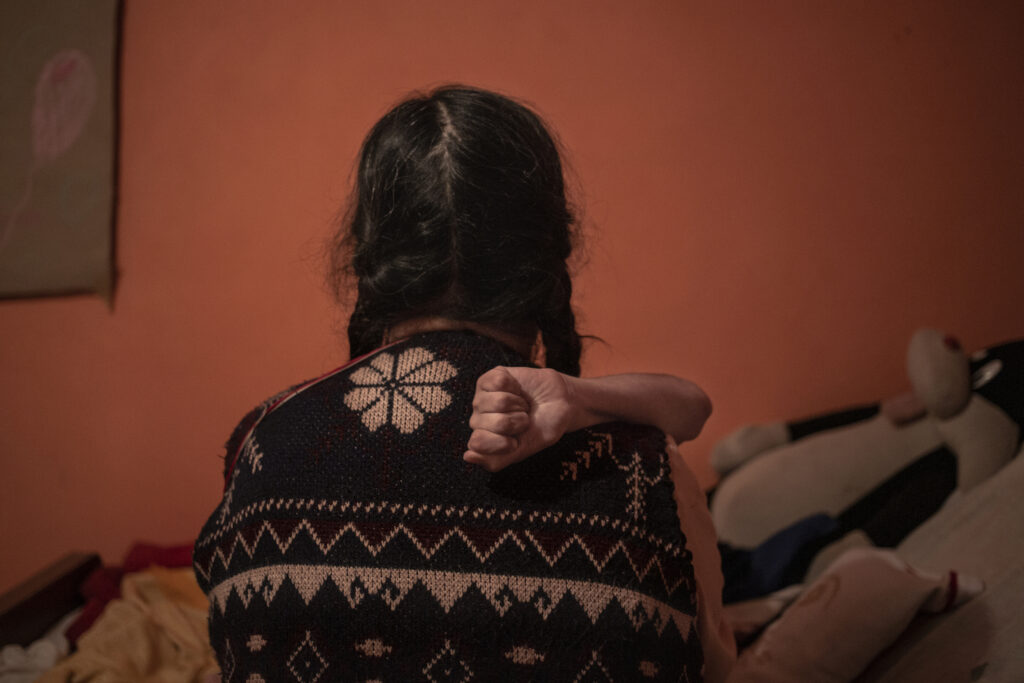
Sebastián’s mother, Doña Petra died in 2020 during the Covid-19 pandemic. She had kidney problems and did not receive medical attention because all regional hospitals were conditioned to treat Covid-19, so people with other disorders were left untreated.
Doña Petra was my first contact in Villa Guerrero. She welcomed me into her home and helped me understand the depths and roots of the health problem in the region. Without her this work would not be possible.
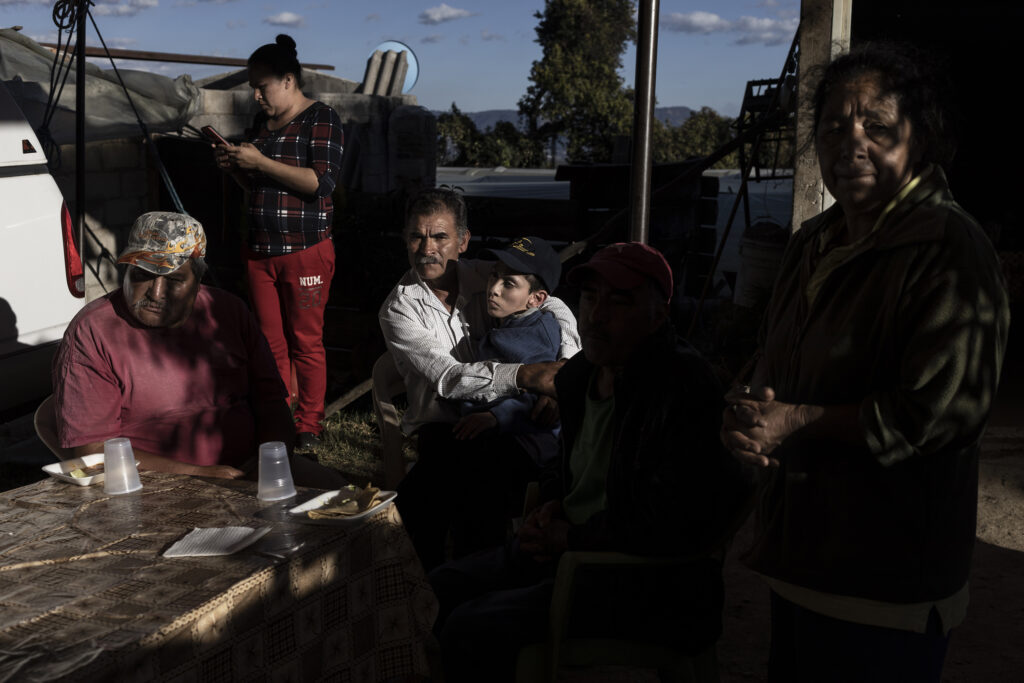
In Carmelita’s family there are also other members with problems caused by agrochemicals, such as Marisela (the woman looking at her cell phone in the photograph) who has had two stillbirths and is currently undergoing treatment to become pregnant because she cannot have children.
MB: It’s familiar.
CRB: Yeah, exactly. It’s a tool.
CRB: These things connect with the people. Because it’s honest.
MB: Yeah, it’s true. And it bridges different cultures. So even if you’re working somewhere foreign and otherwise very unfamiliar, it’s a bridge, right? Something else I wanted to ask you is that – I think with a lot of your work, but especially I’m thinking right now about Beautiful Poison – you capture the complexity of the issue without blaming anybody, which I think is really interesting. You’re showing that these families have so much dignity and are trying to just live their lives and provide and work and support their families, and that they are just part of this larger system that’s a problem. And I think that’s such a nuanced way to approach subject matter… Especially when it comes to environmental storytelling, I think people can be very like, this is right and wrong, this is what’s what, and I appreciate that you show a very systemic layered understanding of a complicated issue. So I’m wondering if you could speak about what the larger systemic conversation you’re trying to show with this project is, and why it is important to take that step back and to look at a system when you’re documenting a story like this which has social issues and environmental issues combined.
CRB: It’s very difficult [because of] three things. The first is the people: the people know that they have this problem. And they say, ‘okay, yes, we know that a lot of people are sick. But what can we do? This is our activity; this is the only way that we know to have money’. I think that the responsibility is not with them. This is the first thing.
The second thing is the government. The government doesn’t have official numbers about how many people are sick from pesticides. Why? Because it’s not good for the government to accept that, I don’t know, 20%, 30% of people are sick from pesticides in Villa Guerrero.
And the third thing is the customers: you know, you and me. I think that this industry gives money to thousands of people and they are not guilty, no? They are only workers. And if I say to the people, maybe to my friends, to my near social circle, you must not buy flowers because these flowers have poison? No, never. Maybe say, okay, you don’t need to be a perfectionist customer and want the perfect flower all the time. This is the thing that I say: only, do you know what happened behind the flower and well, maybe it could be a good thing that you don’t be a perfectionist customer. Only appreciate the flower for the flower and not the flower because it’s the perfect flower.
It’s three different things because there are three different contexts. The people in the groves, they are not guilty. They are only workers. The government is the institution that can do something. They can make public policy, regulate the agrotoxics, give information to these people and say, ‘you can make this with other products more organics’. The government must…
MB: They have power.
CRB: The government has the responsibility to give medical attention to the people that are sick now. And the customer says, ‘Okay, well, we only have the information and we decide what to do with this thing’.
MB: On that note, with all these different contexts, what do you think is the responsibility of the photographer or the journalist or the storyteller in this situation? What is your role in all of this?
CRB: I think that our responsibility is to know the story and tell the story to the people. And I think that the first is to know the story. The second is reflect and have a reflection about the story, about us. In this case: is one town similar to my town? Are its people similar to my people? And what happened with this problem, I was making a reflection. And after that, I decided to make this project in this way. Because one project you can make in a different way, in different narratives, in different whatever… [They] say that we are the eyes of the world. No, we are not the eyes of the world. I have my eyes. I want to know the people, the world. I want to know the different contexts because I have a lot of questions and I need a lot of answers. And for this reason, I go to many places because I want to see. Always, when I come back to my home, I think a lot about the things that I saw in this place. And after that, I need to decide if I am the correct person to tell this story. If I decide that I think that I can make this story, I try to make it the best way I can.
MB: I know you have a background in journalism. Could you tell me about how that shapes your approach to your photography work?
CRB: Speaking of the work on “Beautiful Poison,” ultimately it’s about preserving the memory of my community, the region where I grew up, which is the flower-growing region of Mexico, and documenting this health problem in a way that is intimate and dignified. And that can be done through my work in general as a documentary photographer. I document stories that happen; unfortunately, many shouldn’t happen. But photography also serves as a form of denunciation. It acts as a finger to point out things that shouldn’t be happening. I don’t know, I don’t really think our work has the power to change tragic situations, but it does have the option of denouncing them. And if we have this responsibility, I think we have to do it as best we can and with the utmost dignity towards the people we photograph.
And on a more personal note, I do photography because it’s what I love, because I can’t imagine doing anything else. It’s what makes my heart race, and I’m not just talking about documentary, but photography in general. Sometimes I do business photography, corporate photography, advertising photography, I do behind-the-scenes shots for productions. For me, photography itself gives me peace, it calms me down, when normally I’m constantly thinking about things and I’m in mental chaos because I’m a bit hyperactive. When I’m in the creative process of photography, I slow down and calm down, so for me it’s important.
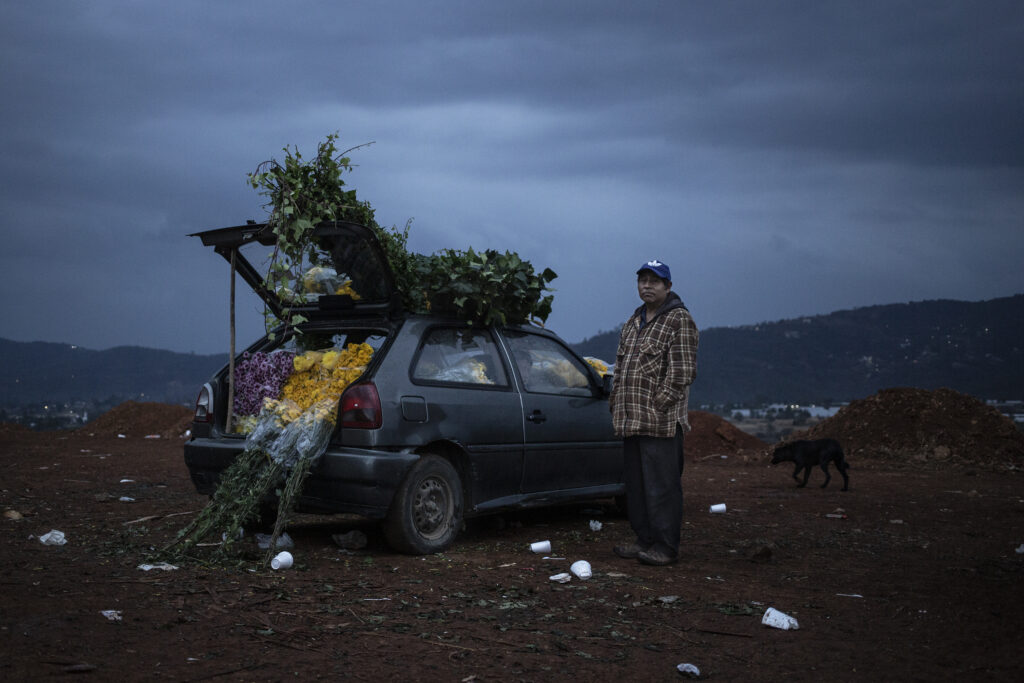
La Finca is the name of the market where the producers of the region take their produce for wholesale. In this market, tons of flowers are sold every day to be shipped around the country and even abroad.
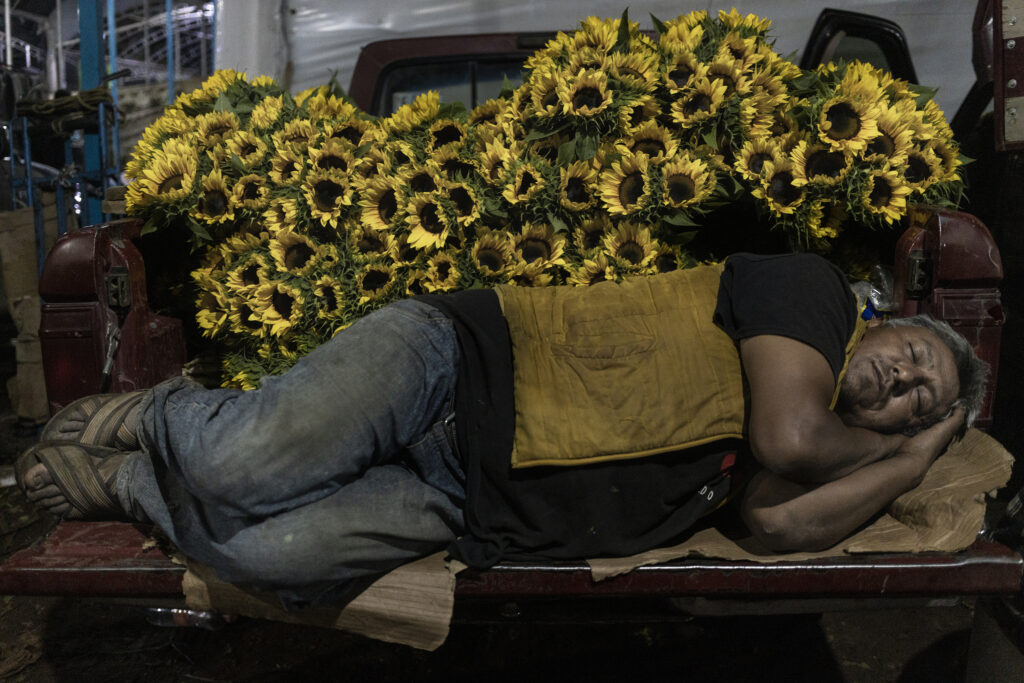
In one of my visits to the flower market documenting the industry’s commercial activity, I saw this man asleep. I didn’t wake him up, I just took the photo.
MB: So what are you working on now? What’s next; what are you busy with?
CRB: Well, I recently finished a new project about extreme wrestling near Mexico City. It’s a little project. Well, a little project for three years. I think that it’s a little project, but I think that when I finish it, it’s a big project. Now I want to continue a work similar to Beautiful Poison in the same way, both here in Mexico City. I will try to begin this next Friday because [whenever] I don’t have work with other clients, I go to this place. In the north of Mexico City, maybe one hour, one and a half hours from here, exists a reservoir. In this one arrives all the sewage or wastewater from Mexico City. It’s all going there. The shit. And I know that the people who live near to this, they have skin problems. And I began to document or read about the project, and I thought that I needed to go first and look at the place, connect to the people. Because these are my steps. The first: go scouting. After that, connect to the people, build confidences, and very slowly take photographs. I told you that [this project] is the same way to Beautiful Poison because in Beautiful Poison there are the congenital problems from the pesticides, and in this [new] work there are the congenital problems from the shit of Mexico City, more or less. This is the next project.
MB: There’s a real theme there of health, and the connection between health and infrastructure.
CRB: I don’t know now how [I will build] the photographs, but I imagine similar to Beautiful Poison – but contrasted with this big city. Making a comparison. I think that this is important because the water problem is a global problem. This is pollution from Mexico City, but it’s connected to the environment. It’s connected to the water. It’s connected to the global problem in a lot of countries, in a lot of the world.
MB: Is there anything else that you want to make sure you speak about that gets into the interview?
CRB: Well, I want to give thanks to my mother, because she was the first person that put a camera in my hands, and I think that I’m a photographer because of my mom. I am the first photographer in the family. I am the first artist in the family. But my mom, when I was a child, worked selling photographic products. For this reason, she had a discount on cameras and she bought one camera for me and bought one camera for my brother. My brother didn’t care for the camera. But me, I took photographs all the time. And I think that she’s the origin of my career, my mom.
MB: I love that. Do you ever photograph your mom?
CRB: Yes, a lot of photographs. She doesn’t like it, but sometimes I tell her: Mom, let me.
CRB: Well, thank you, thank you, thank you for this interview.
MB: No, thank you.
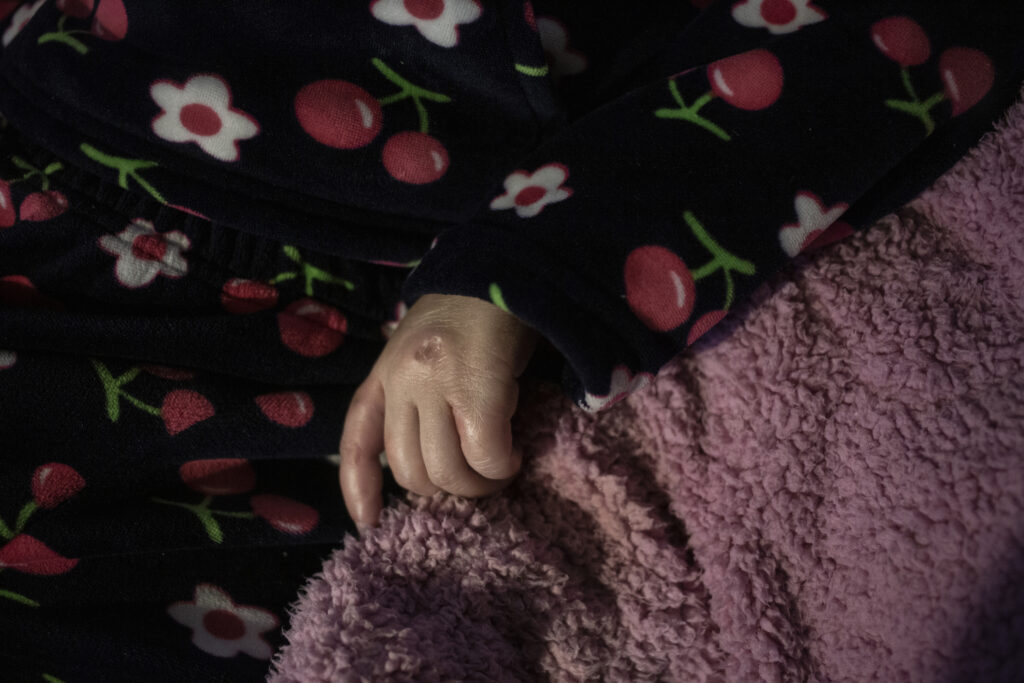
Carmelita’s mother explained to me that the photosensitivity caused by encephalomalacia puts Carmelita under great pain, so she cannot leave the darkness of her room. Her mother gave me consent to take these pictures after I thoroughly explained my project.
BEAUTIFUL POISON is a long-term photography project documenting the public health problem associated to the unrestricted use of agrochemicals by the flower industry in the region of Villa Guerrero, Mexico. Despite conclusive medical studies linking pesticide and fertilizer components to the recurrence of congenital malformations, leukemia, lymphoma, degenerative blindness, stillbirths, infertility and cancer, the healthcare demands of the population in Mexico’s flower belt have largely been overlooked by local authorities and institutions.