Citizens pivoting toward drone-making reveals how ordinary people reshape their lives to meet the needs of their communities in a time of war.
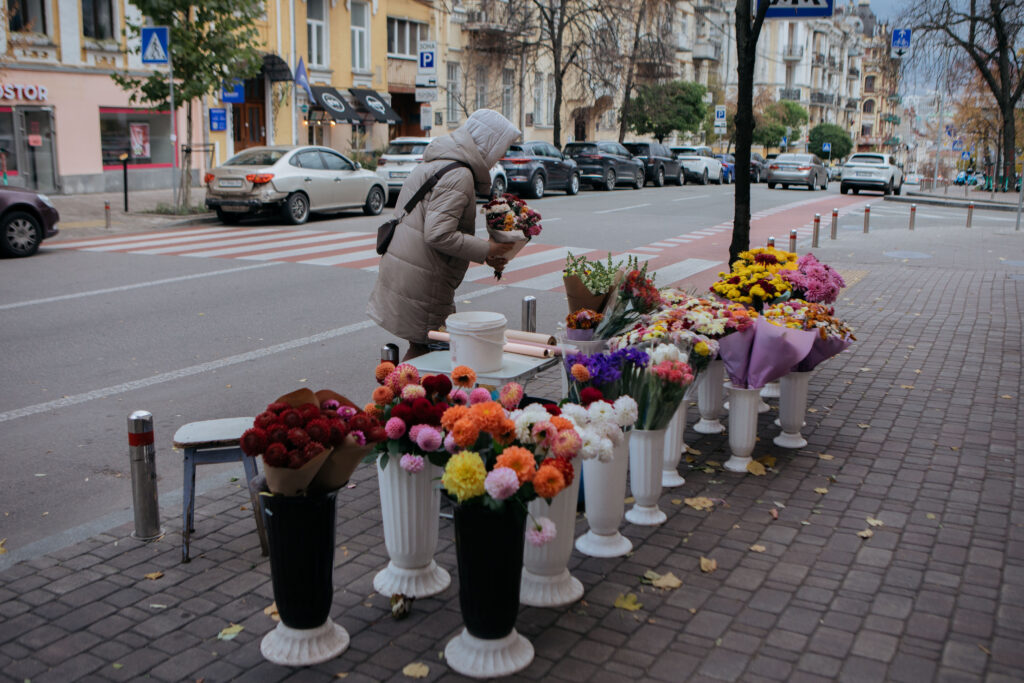
Last summer, 36-year-old Kseniia Kalmus lived what she describes as a life of surrealism. She would wake up early in her forest cottage in Kyiv’s periphery, which she moved to with her two big dogs after the full-scale invasion by Russian forces on February 24, 2022, to harvest a fresh salad from her garden. When the mood struck, she might pull together a bouquet or two. Kalmus has a proclivity toward chrysanthemums—before the war, she was an award-winning florist. Then, she would drive to a secret location in the Ukrainian capital to assemble first-person view (FPV) drones with her small, dedicated team of volunteers.
The day the war started, the flower shop that Kalmus co-owned prepared a bouquet for a company’s show of employee solidarity, in the face of rising anxieties surrounding Russian aggression. Such ridiculous irony, she remembers thinking. With her country under attack, Kalmus found it impossible to continue working as a florist.
Kalmus joined the Livyj Bereh, a humanitarian organisation, rebuilding 400 roofs and three schools damaged from shelling over more than two years of war. But when sustained Russian attacks repeatedly destroyed their projects, she had the revelation that reconstruction work would remain futile unless the root issue was addressed.
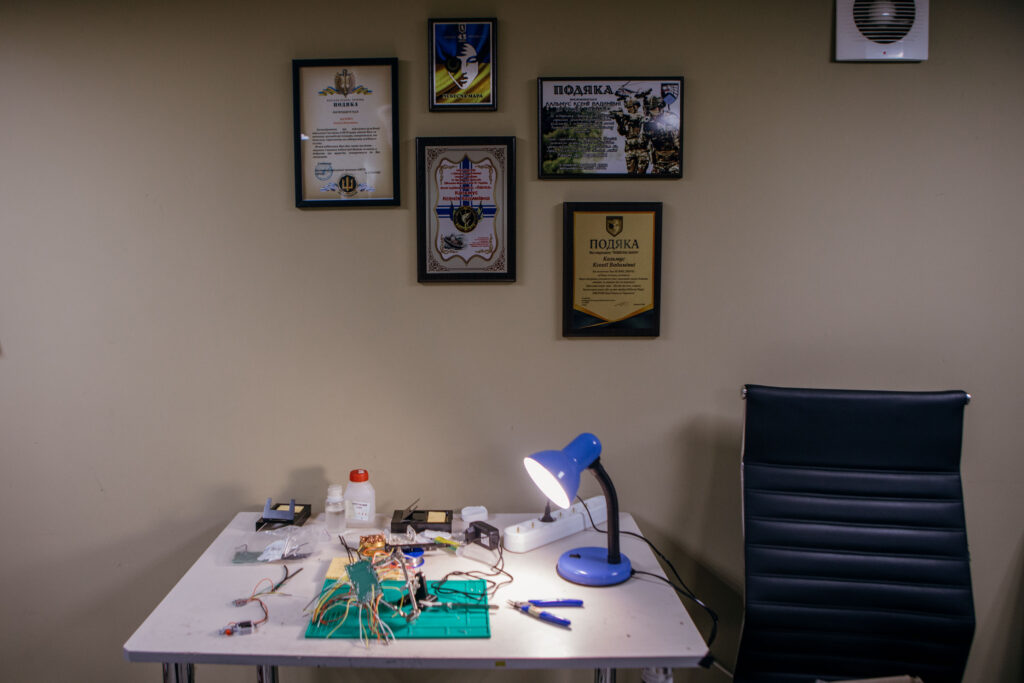
She founded Klyn Drones in 2024 (its ‘V’ shaped logo inspired by the formation of migrating birds, plus drones flying toward the enemy), repurposing the flower shop she co-owned into a modest FPV drone workshop. She took several engineering courses to learn the basics about drone assembly, plus a piloting course. “It was a really good school that doesn’t want to admit civilians,” she recalls, “They mostly work with the military. But I wrote a CV explaining that I support the military a lot, and was looking to train other civilians in a drone workshop, and they accepted me.”
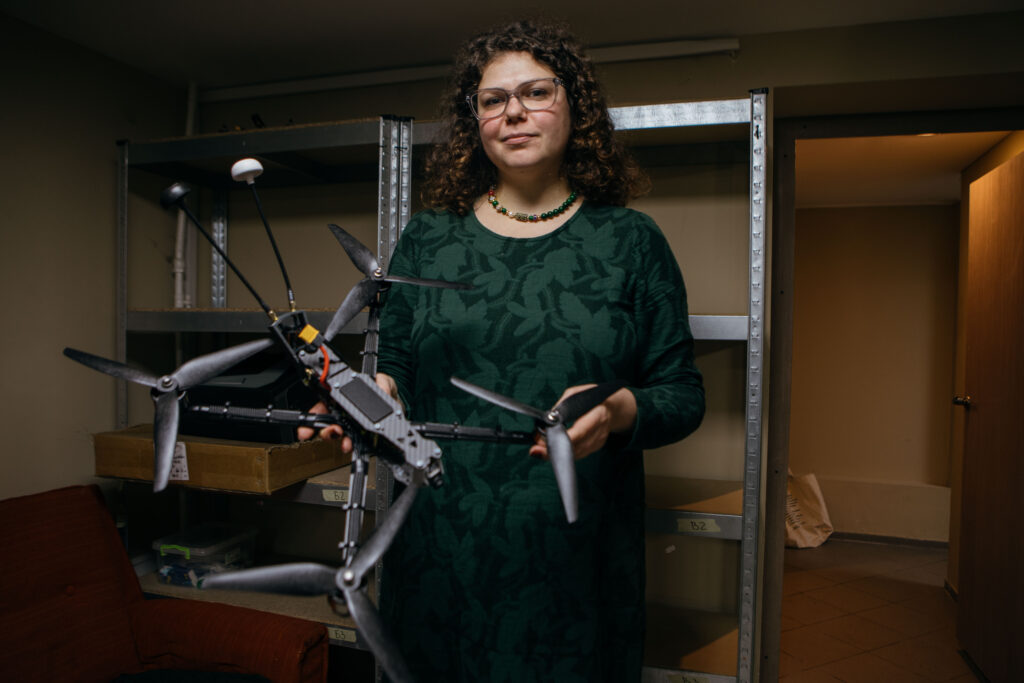
“I have close people in my life, including my brother, who need drones.”
In the piloting course, she was the only female out of her 70 other comrades, whom she describes as tough guys who had liberated the eastern Kharkiv and Kherson regions. Upon completing the course, she has continued cultivating relationships with instructors there. They test and provide vital feedback on Klyn drones, which Kalmus and her team directly implement into their next batch. “The military really needs drones,” she says from the basement workshop. “I have close people in my life, including my brother, who need drones.”
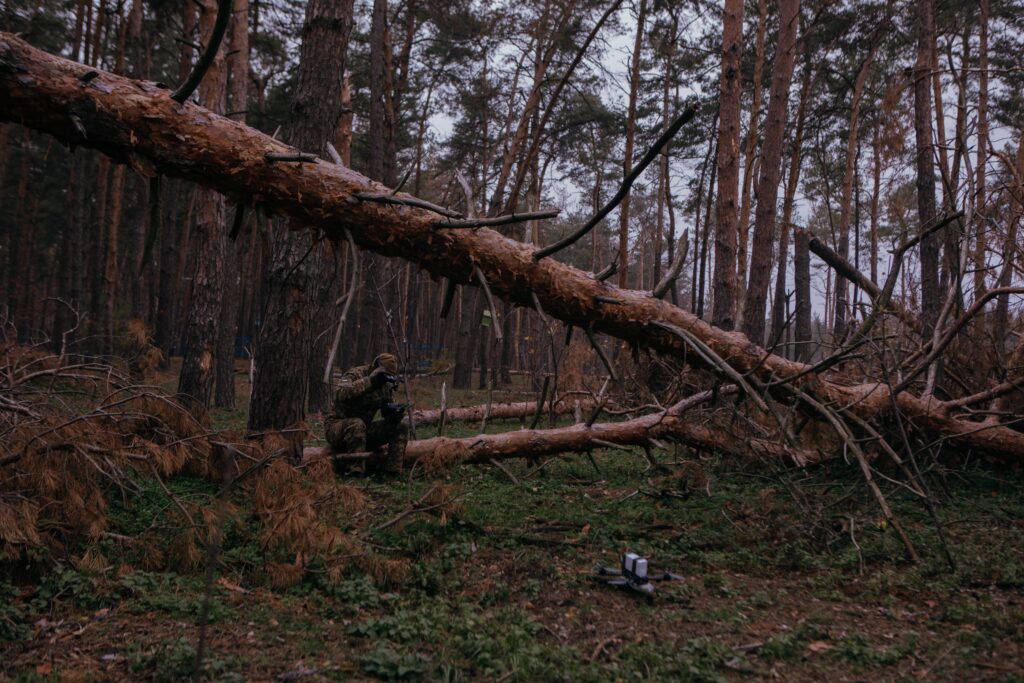
“We have a lot of requests,” says a drone pilot belonging to the 13th Khartiia Brigade from a forest outside Kharkiv city on the eastern front during a flight practice session. “There’s a lot of bright people, who have a lot of will, to make this work [on the other end].”
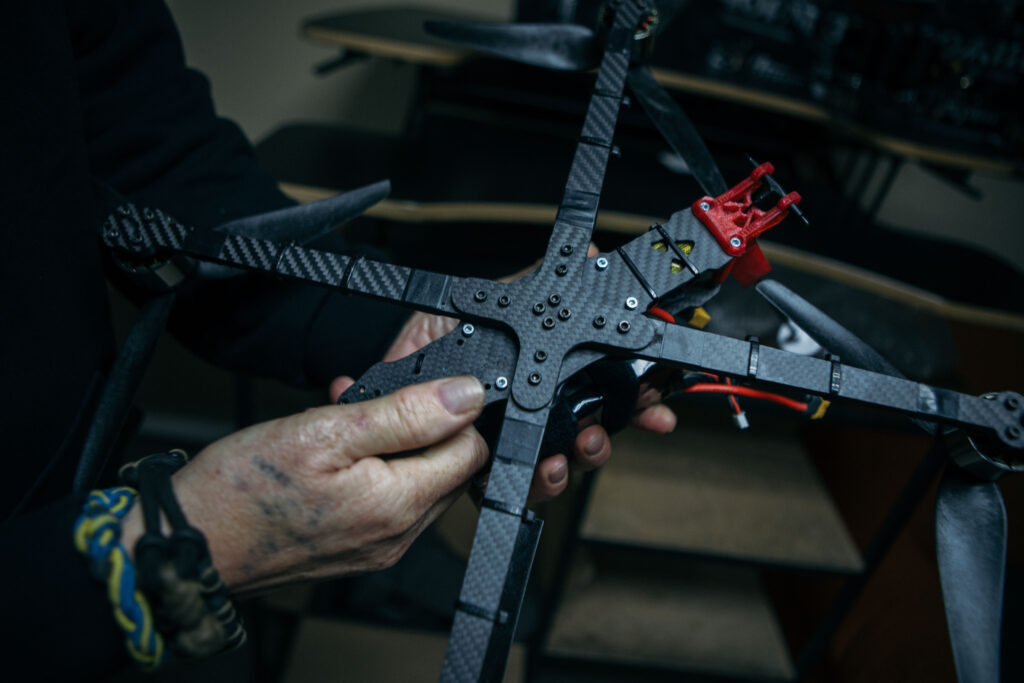
Klyn’s most popular FPV drones are 10-inch Kuripkas, but they can be fitted with a wide range of modifications depending on the frontline unit’s requests: different video receiving frequencies; analog, night vision, or digital cameras; various controlling frequencies. They also produce 7’’ and 8’’ drones, and are in the process of developing 13’’ Kuripkas.
At present, Klyn shuttles drones directly to six frontline brigades, having supported 15 different units since its inception. Across Ukraine, civilians have a clear-eyed comprehension of what is at stake: what their nation needs to survive. In occupied territories such as Luhansk, and Donetsk, plus partly-occupied Kherson and Zaporizhzhia, Russian criminal and martial law are invoked when convenient, resulting in illegal detention, extrajudicial punishment, and disappearances of Ukrainians. Coercion, digital control, and ubiquitous surveillance have become the norm.
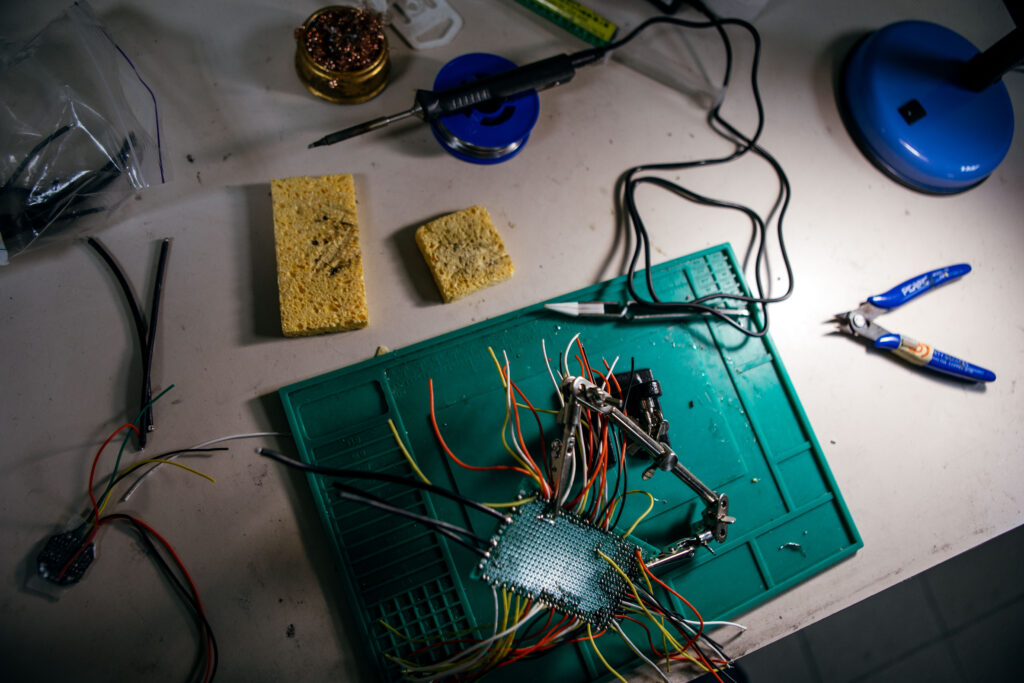
This direct developer-to-frontline pipeline, fueled by private sector technologies––repurposing commercial drones and private satellites for attacking and spying, meticulously refined by volunteer hackers—has been a hallmark of Ukrainian ingenuity and innovation in the most technologically advanced war in history. Civilians have stepped up to bolster Ukrainian defenses where western governments have failed. By the end of 2023, drones emerged as the war’s defining force. Infantry units have strategically pivoted to drone piloting; Ukrainian teams work around the clock, destroying billions of dollars’ worth of Russian equipment. Previously used mainly for reconnaissance, drones have become this war’s pulsing lifeblood.
Even as one of the most high-profile wars in the world right now, Ukraine remains underbacked: as leaders of the European Union remain sharply divided on a ‘reparations loans’ to Ukraine, which would use part of the $300 billion in assets of the Russian Central Bank—imobilised when the Federation invaded Ukraine in February 2022—as part of an interest-free loan to Ukraine. This would mitigate Ukraine’s dire fiscal needs: the International Monetary Fund estimates that the war-torn nation needs $135 billion euros in 2026 and 2027; Ukraine has a state budget deficit of roughly $44 billion—18.5% of its GDP.
With growing frustrations toward lackluster governmental attitudes of what is at stake with Ukraine, foreign civilians have been making their way to Ukraine, open-hearted in their desire to contribute to the war-battered nation’s defense. Klyn has become a community space where people from different ages and backgrounds teach each other and work side by side, united by the same purpose. Kalmus says that they have trained hundreds of volunteers in drone construction.
62-year-old Stephen Stratton doubles as Klyn’s volunteer coordinator and a drone engineer, having served in the Royal Air Force and worked in the humanitarian sector. He has been volunteering in Ukraine since early 2025. From its genesis, Klyn was intentional about sourcing the majority of its parts domestically, and now has the capacity to assemble drones from 100% Ukrainian-made parts. “This allows us to support Ukrainian manufacturers and the economy,” Stratton explains. “Moreover, we get better quality and service because everyone in Ukraine understands the importance of what they are doing and manufacturing—they’re not just doing it for money.”
The market for drone parts expanded rapidly with the onset of the war. Although frames, flight controllers, and cameras can now be readily sourced across Ukraine, a residual reliance on Chinese-made parts–mainly video transmitters and radio receivers—remains. The Ukrainian market has yet to cover all the frequencies military units might need, Stratton explains. At present, most drones going to the frontlines may be constructed from 75-85% Ukrainian parts, he continues. But this may soon change as the market expands and fills the requirement gaps of drone makers and military units, with no end in sight for the war.
Klyn is nearly wholly donation-based, and as of the end of 2025, has produced roughly 1100 drones. “We have the capacity to make one thousand drones a month,” Kalmus adds, “Should we have enough funding.”
Her pitch to donors is convincing: “A $340 drone disabling a $1.2 [million] Russian tank—that’s 3,600 [times] the bang for your buck.” Christopher Cavoli of the U.S. European Command, who doubles as Supreme Allied Commander Europe for NATO, says that Russian ground forces have lost 3,000 tanks, 9,000 armored vehicles, and 13,000 artillery systems, describing Ukraine as ‘world leaders in one-attack drone technology.’
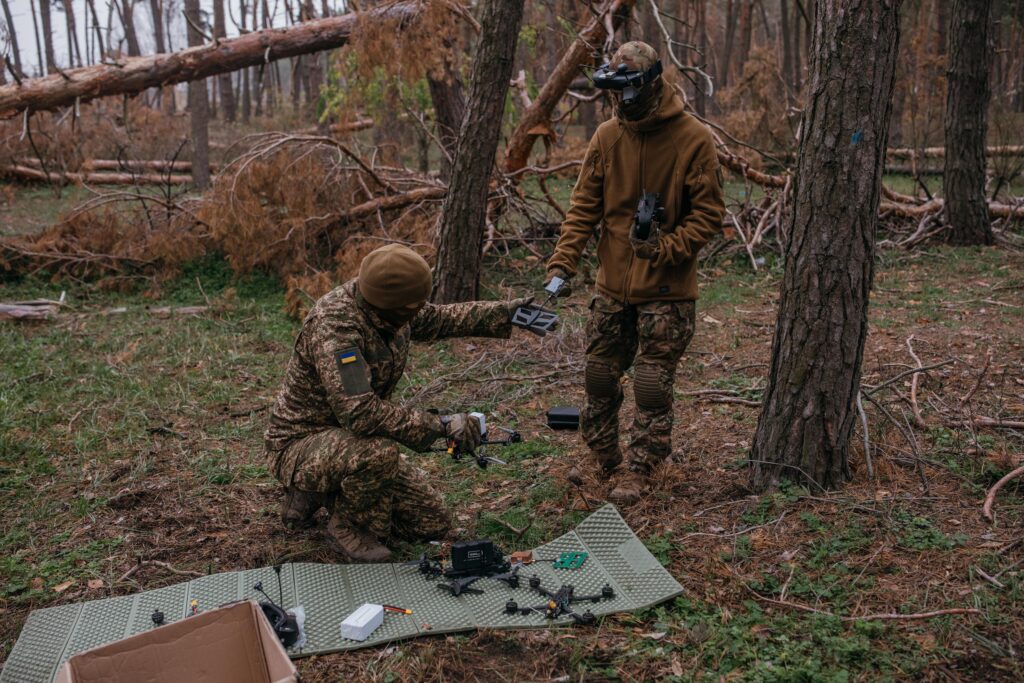
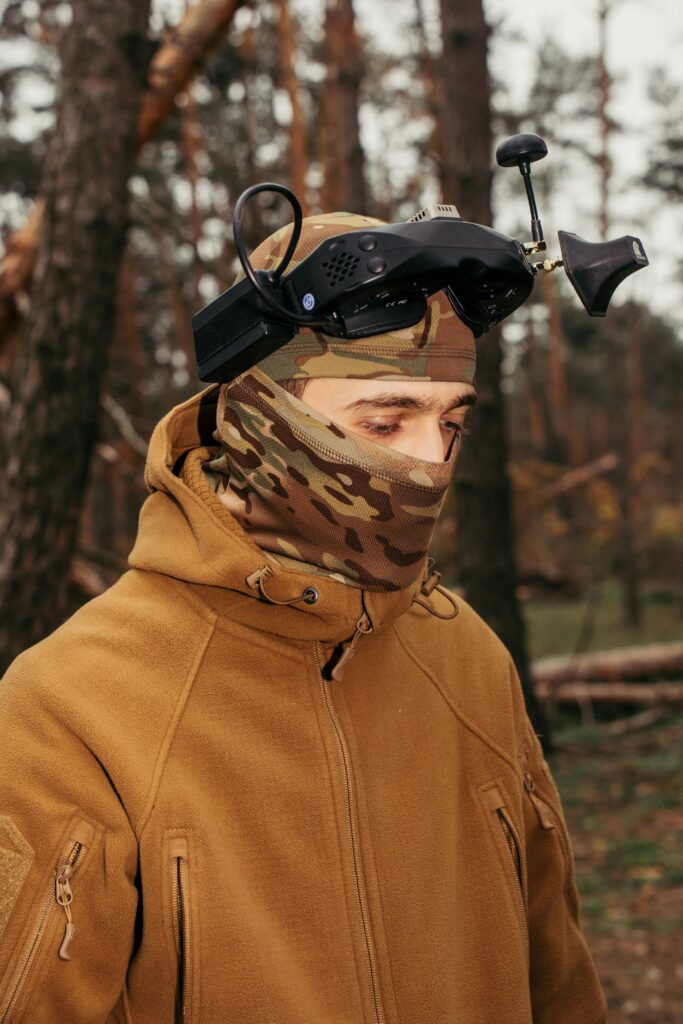
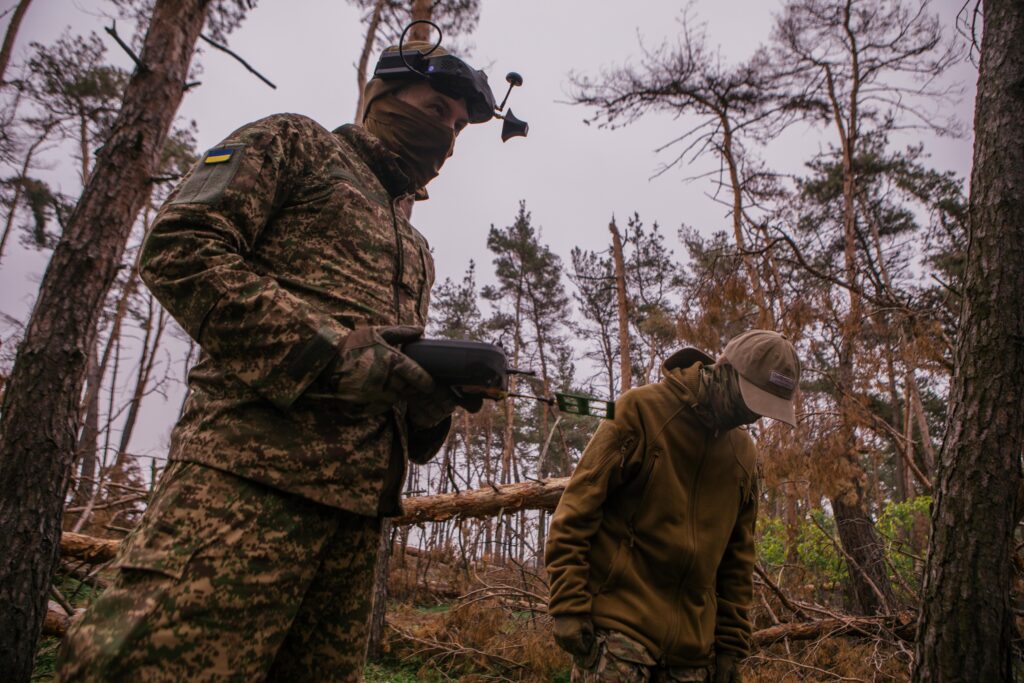
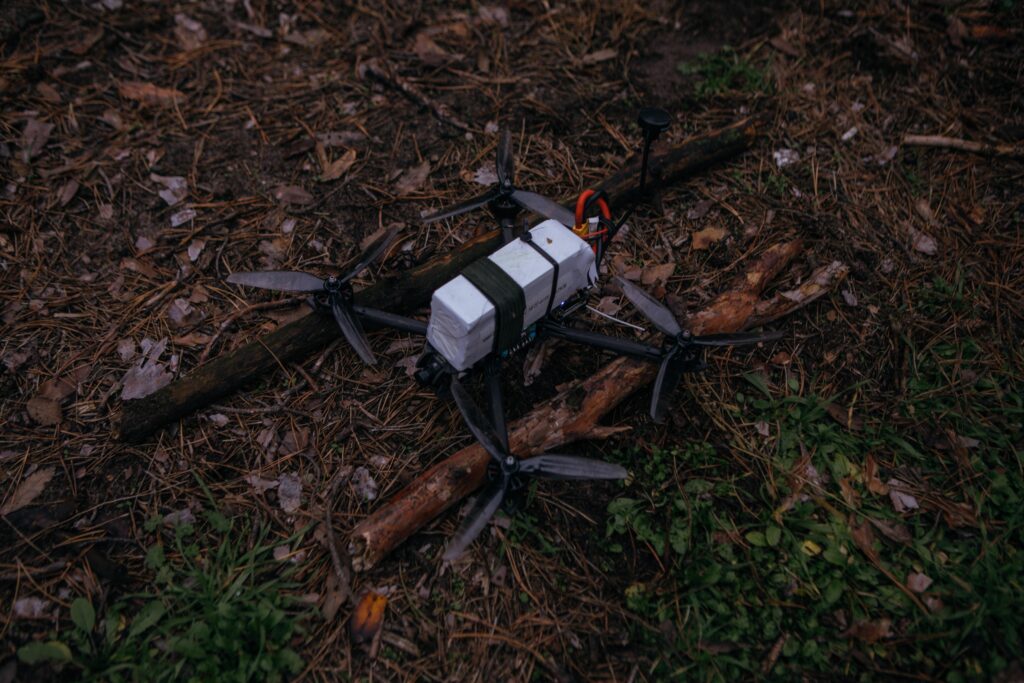
“We get better quality and service because everyone in Ukraine understands the importance of what they are doing and manufacturing—they’re not just doing it for money.”
Still, Russia has been relentless with its drone attacks, targeting energy infrastructure, leaving hundreds of thousands without electricity or running water in the dead of winter. The nightly terror of drones and air raid alarms have been ongoing blows to morale. Ukrainian intelligence reports that the Kremlin can produce 2,700 Iranian-designed Shahed attack drones a month; on September 7, 2025, Russia launched 805 drones and decoys into Ukraine, the largest attack of the war thus far.
In Ukraine, a mental health crisis has been unfolding, with antidepressant sales doubling, rates of severe anxiety and PTSD surging. On the Russian side, Ukrainian retaliatory drone strikes have cut off electricity for hundreds of thousands in the capital city of Moscow. Even amidst the inevitable routiness of such a protracted conflict, Russian public morale is blooming into anger and frustration for a war that the Kremlin has resolutely dragged out, seemingly unperturbed by the 1.2 million casualties since the beginning of the full-scale invasion—a figure unseen since World War II.
The Russian economy cannot sustain the burdens of war forever. Civilians are living the contradictions of an economy bolstered by wartime booms yet stilted by Western sanctions The Kremlin’s iron fist continues violently suppressing restiveness of society at large, yet Russia is wading into its psychological crisis, a population torn between nationalistic zeal and regime opposition. Assimilation of soldiers from the notorious ‘meat-grinder’ back to society has been studded with challenges; The Moscow Times reports that veterans have killed or injured more than one thousand people since the full-scale invasion.
Ukraine is the breadbasket of Europe, if not the world, exporting more than 60 million tons of grain a year prior to the full-scale invasion—a tenth of the global market according to the Council on Foreign Relations. Russian blocks on grain exports, 90% of which pass through Black Sea ports, have been a deliberate strike on Ukraine’s economy. Downstream, on the African continent and in the Middle East, Ukraine’s primary recipients have been feeling the blows, adding pressure to countries with the least economic resilience.
64-year-old Eugen Ischenko-Giller grew up in Donetsk Oblast, now considered the last eastern stronghold which has seen the majority of heavy fighting in recent months—a telltale consequence of Putin’s obsession.
“All my life, I spoke Russian,” says Ischenko-Giller through a translator—common across eastern Ukraine. In the 1980s, he had a flower farm business with his brother that halted with the collapse of the USSR in 1991. This ushered in his transition to selling agricultural equipment such as fuel and fertilizer, before Ischenko-Giller tried his own hand at farming.
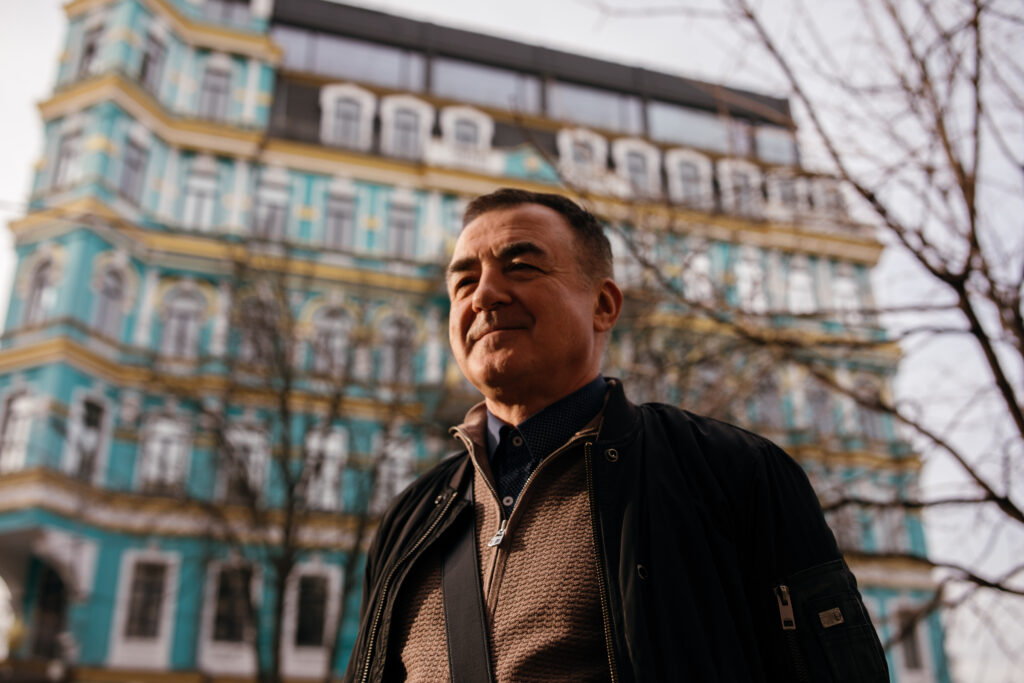
“It was impossible to move crops out. Western borders had a low capacity to move, so we couldn’t export. The surplus meant that all the prices plummeted.”
At the turn of the century, he founded BIG Harvest Group and served as CEO. They began with 700 hectares of wheat, sunflower, rapeseed, and barley, sold to both traders for export and on the domestic market. His farm did well, and they added land incrementally. At its peak before the Russo-Ukraine war in 2014, the farm covered 40,000 hectares, cultivated by 500 employees. He was on holiday in Crimea when the war broke out and was unable to return to Donbas to take care of the croplands.
Upon his return, 12,000 hectares of the farm were seized; Ischenko-Giller estimates roughly 28,000 remains in Ukrainian-controlled territory, which continues dwindling with each wave of Russian occupation. Consequently, 10,000 tons of grain was left rotting in storage, with damages from loss of land and stolen or destroyed equipment amounts to $100 million. He was burdened by $25 million in debt from large loans for his farm’s expansion, which he managed to clear by 2018.
Ischenko-Giller had already secured 1500 hectares outside the ancient city of Chernihiv in northern Ukraine in 2013 and decided to pivot his efforts there. As of late last year, he had 13,000 hectares in Chernihiv, having branches into dairy farming in addition to grain. But the 2022 full-scale invasion brought a horrible deja-vu, grinding normal life to an eerie halt. Early spring was approaching––they were about to begin the season’s planting and put down fertilizer.
A mere 30 kilometers from the Belarusian border, Russians immediately occupied his farm. “Luckily, no one was killed, but they took the keys to our equipment, stole our radio systems.”
Ischenko-Giller recalls the painful memory of pouring out countless liters of milk into the canals produced by his 2000 dairy cows. “We started giving milk, grain, and flour out to civilians since the communities around us didn’t have any food,” he shares. “Once again, we were at risk of losing everything.”
“It was impossible to move crops out. Western borders had a low capacity to move, so we couldn’t export. The surplus meant that all the prices plummeted,” he explains. Even though the Russians have retreated from Chernihiv around, there’s the psychological damage that remains—the humiliation and indignation—dangerous aftermath in the form of unexploded rockets embedded deeply in the fields.
“What people who aren’t in Ukraine don’t understand is that, if Ukraine falls, they are next,” according to Kalmus. “Ukraine is a strategic question for them—if they support Ukraine, there will be a life for them also.”
This reporting was supported by the International Women’s Media Foundation’s Women on the Ground: Reporting from Ukraine’s Unseen Frontlines Initiative in partnership with the Howard G. Buffett Foundation. Tetiana Burianova contributed reporting to this story.