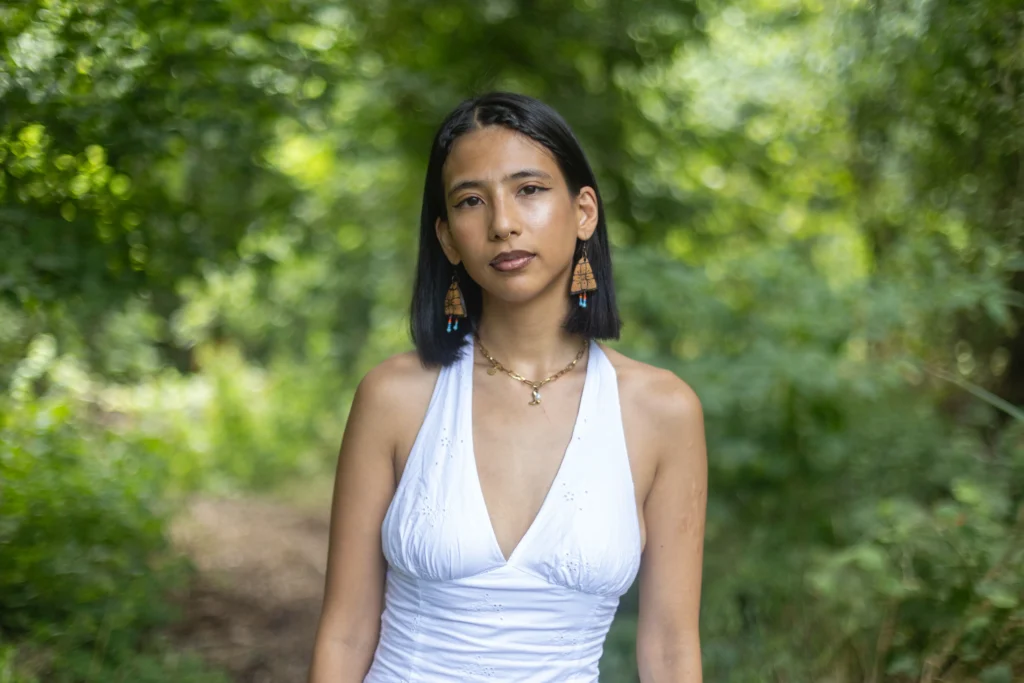
It’s a strange time to be a climate activist. Alexia Leclercq, however, was born into strange times. She arrived earth-side at the turn of the century as Y2K fears came undone, climate champion Al Gore lost his White House candidacy, and the U.S. entered into war with Iraq after the 9-11 terrorist attacks.
Twenty-six years later, the now executive director of the Land Justice Community School sees parallels between her early years and the ones ahead. Computers aren’t melting down, but they do appear on the verge of global domination as governments give AI companies free rein. U.S. voters have yet again rejected an environmentally friendly presidential candidate. Instead, Donald Trump sits in the White House, where he has signed executive orders and memos that have extended the life of the coal, oil, and gas industries.
“As young people, we’ve always grown up in a world that’s on fire,” she said. “That’s all that we’ve known—politically but also literally with the climate crisis.”
Global catastrophe is tough to control, so Leclercq likes to focus on what she can accomplish locally. She stays rooted in Texas, where she grew up, looking for opportunities to help how she can. In Texas, many of her peers mistook her Taiwanese heritage for Mexican or Native American. “Once when I was 16, some random lady screamed at me to go back to Mexico,” she recalled. Leclercq has used this to her advantage to build coalitions and connect communities across ethnicities and party lines. Indeed, the last 10 years of her life have been spent organising her Texan neighbours to secure affordable housing and shut down a proposed military facility.
This interview has been lightly edited and condensed for clarity.
Yessenia Funes: How did you become a climate activist? What drew you into this environmental advocacy work?
Alexia Leclercq: My mother taught me that we are all connected to each other and to Mother Earth. And I grew up with Buddhism, traditional knowledge, stories of tree spirits, and Chinese medicine. So, it’s always been a part of me. In middle school, my school didn’t have a recycling programme, so I led a campaign to establish one. And from there, I got into the youth climate space and grassroots environmental justice organising spaces.
YF: I know you’re in a period of transition. What does your work look like these days?
AL: Most recently, I was part of the six-month-long Eahou Fellowship, which is run by a Native Hawaiian organisation called the Purple Mai’a Foundation and Breakout. It’s focused on sovereignty. How do we incorporate traditional ecological knowledge at the centre of that? How do we create alternative systems?
I’ve been in the environmental justice space for a decade now, mostly leading campaigns on the frontlines, but over the past year, I have been thinking a lot about how we move toward building systems by and for our communities. I’m supporting the building of a food co-op here in Austin and thinking about community land trusts, community-owned systems, and doing the base building and the visioning to get there.
YF: That’s incredible. I love that you’re still on the community land trust work. But you’ve done a lot of different types of work – from on-the-ground community organising to international U.N. spaces. What type of work do you find most fulfilling and why?
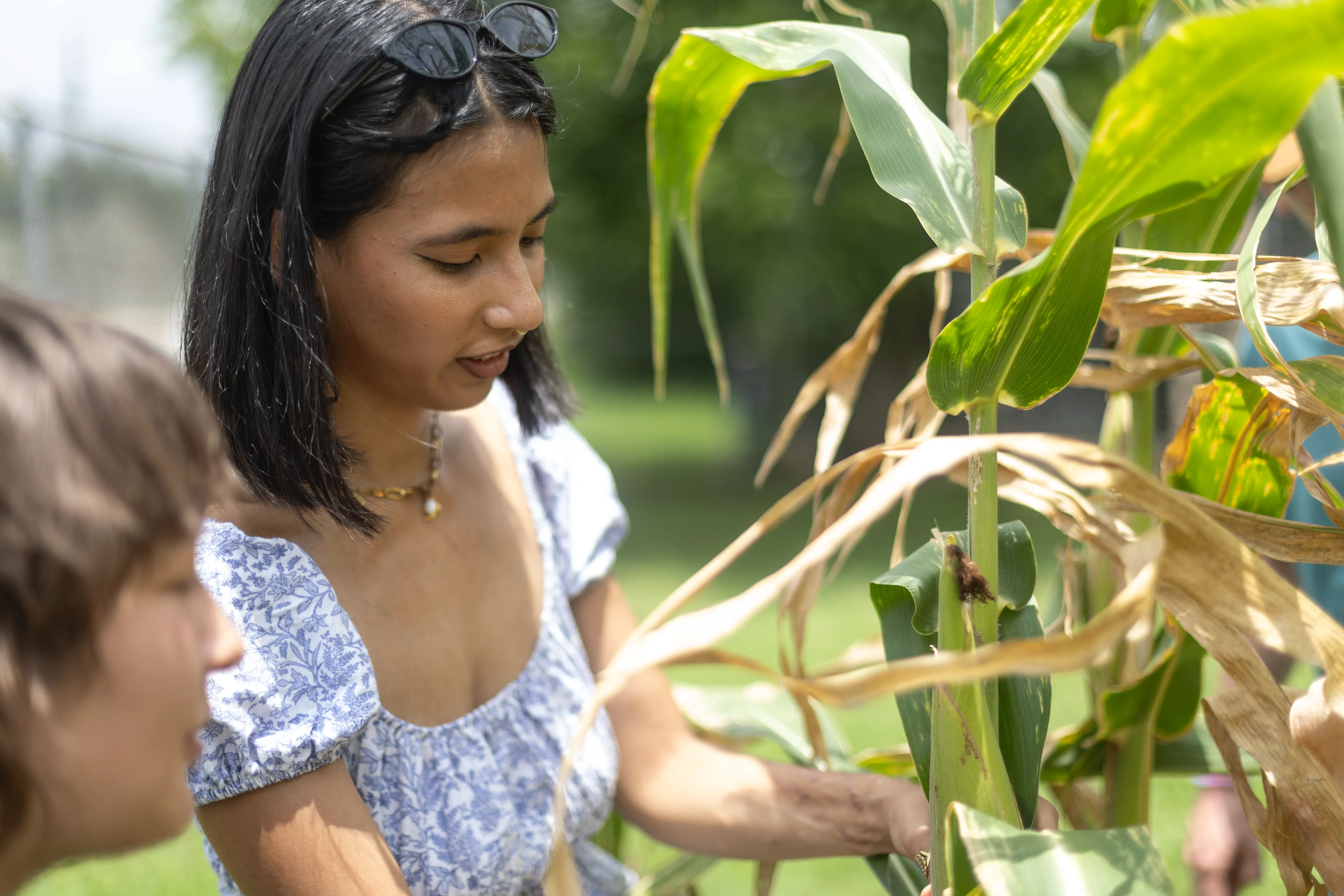
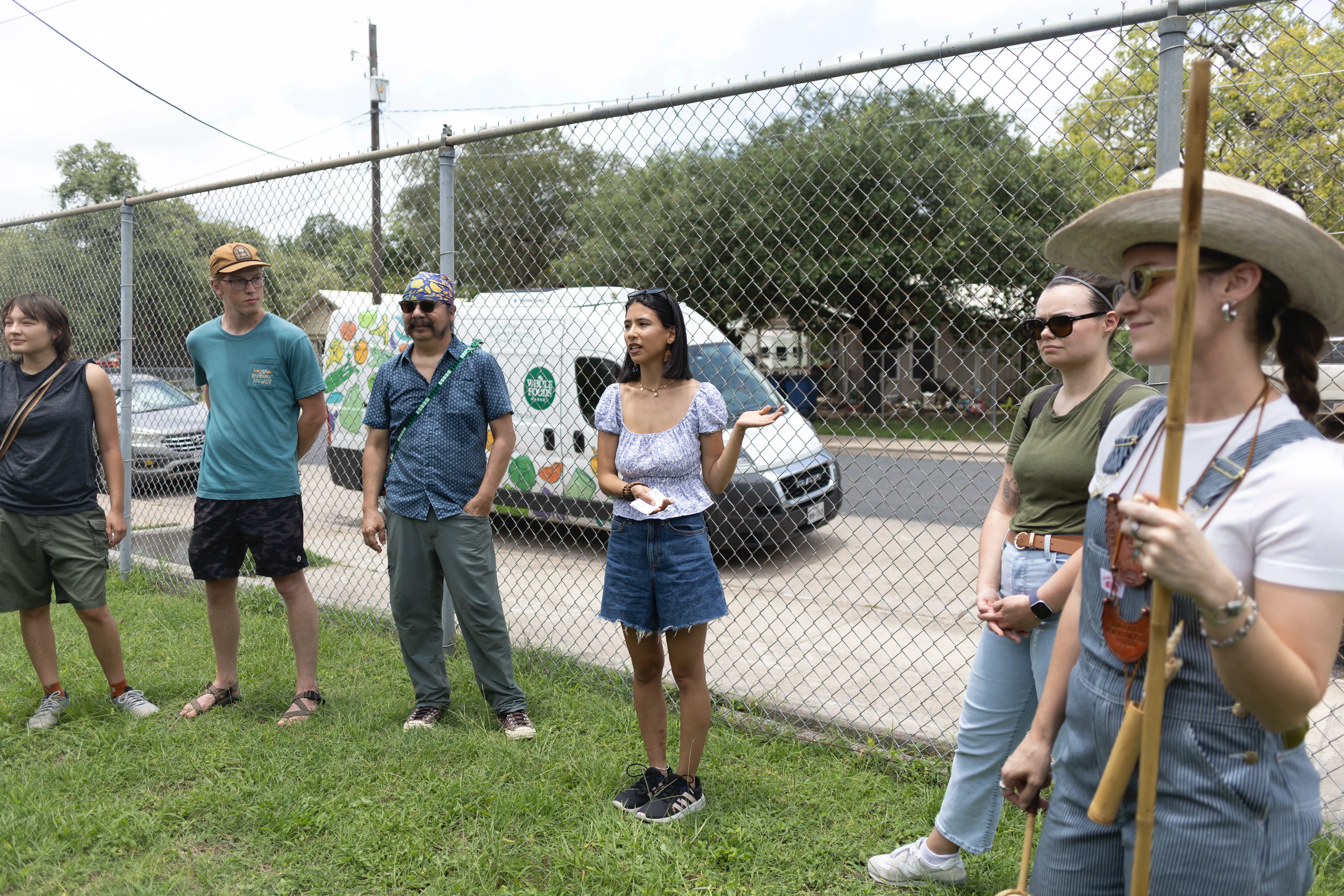
AL: Working with youth and young people because they are our future. Ensuring that young people are proud of their own cultures and understanding how their traditional knowledge systems are wisdom and that there lies the solution to the climate crisis already. It’s important that youth of colour, in particular, have access to their knowledge and resources to shape their own communities and futures. It brings me so much joy to work with our young people.
YF: Many would still consider you a young person, too!
AL: That’s true. I’m talking about high school students, but also my peers.
Our movements need to be intergenerational. That’s a big gap. How do we build youth and elder relationships? How do we pass down the knowledge that already exists, but also bring in this new energy and vision and ideas?
Because it’s not only our future – but the future of our movements. Are they going to be sustainable? Are we going to win? Are we going to build liberated futures? It really depends on the youth.
YF: Why is intergenerational coalition-building particularly relevant when we think about the climate justice movement? Why is this a unique movement for this type of collaboration to take root?
AL: When I first joined the environmental justice movement, I remember attending the 2019 Environmental Justice Leadership Forum meeting organised by WE ACT Coalition in Houston, Texas. And I was the only person under the age of 35 back then. And I think it’s come a long way, but the movement was largely elder-led. A lot of times, environmental justice organisations don’t have the resources to invest in youth leadership because they’re putting out 20 fires at once.
For me, coming into this space as a young person, I really want to create space for young people. Because at the end of the day, who the climate crisis impacts the most is youth and future generations. And at the same time, we’re literally growing up in this world that’s on fire. And we are experiencing all the multitudes of crises happening at once. And I know as a teenager, I felt so much angst about the world. And I’m so grateful that I found movement spaces and was able to channel my energy into trying to create change and fighting for my community. I want other young people to have that pathway as well.
YF: Yeah, and elders, especially in the climate movement, often have roots in other movements and have so much to share from civil rights, feminist organising, or queer organising. And that passing of the baton is really critical to build that sustainability you mentioned earlier.
AL: Yeah. We do have a serious crisis of mass burnout in environmental and climate justice and all justice movement spaces. One of the solutions—it’s not a fix-all—is to create more intergenerational movements and ensure that we are bringing more young people in and providing them the resources and tools to develop their leadership. So, the burden is not on the same people who have been leading the movement.
That way, we can create greater capacity for joy, for bringing more people in, for more leadership development pathways, for mass organising, and for creating alternative systems.
YF: In the U.S., and increasingly in other parts of the globe as well, data centres are becoming a hot-button issue. I know it’s also an issue you’ve worked on that affects where you live in Texas. How has the rise of data centres affected the trajectory of your own work and your focus these days?
AL: A couple years ago, I was working for the city of Austin and wrote a climate adaptation report on drought. I used data from these interdepartmental workshops that we led and recent climate research. The first paragraph of the report was a sentence I wrote about how drought impacts soil elasticity and that hurricane season would make Central Texas particularly prone to extreme flash floods. And the report specifically mentioned summer 2025.
And then summer 2025 rolled around, and the extreme flash floods came, and hundreds of people died. Even the bridge that’s 15 minutes from my house collapsed, and a couple of people died over there. That was a very Octavia Butler-like moment of seeing the climate research I had written in the report come to life. The drought here in Central Texas is really bad – and now we have 55 AI data centres coming in. We have the research about how much energy and how much water that is using.
I got involved with some of the local zoning fights and was actually invited to the Take Back Tech conference in April, which was really cool because there’s another issue around local governance and economic development. Who are we building these centres for? Who is this profiting? Who gets to control how these decisions are made? How are we taking care of our land and our water? This AI fight gives us a new opportunity to reimagine entire systems and move toward community-led governance systems.
YF: I also think a lot about what these data centres are powering: digital robots that are disconnecting us even further as a society and isolating youth. It reminds me of what you were talking about earlier about the importance of connecting young people to their land and traditional cultures and values that are at the heart of environmental and climate justice organising.
AL: Especially as an artist, I’m extremely concerned about AI itself, as a tool and its existence. Whose art and whose creations is it exploiting?
YF: I love that you named yourself an artist. You have so many titles, and there are so many multitudes to your work. I know you’ve been doing this for 10 years, but that’s because you began working as a teenager, right? Yet you’ve already accomplished so much this past decade. Talk to me about the successes you’ve seen and the impact you’ve had.
AL: Thank you. The thing that I’m most proud of is the curriculum suite that we built out through my non-profit, the Land Justice Community School. We’ve been able to reach over 120,000 youth across the U.S., which is kind of mind-blowing. That curriculum really centres justice and traditional knowledge in climate science. The other thing I’m most proud of, that’s kind of my baby, is our Land Justice Organizing Fellowship, which we started in 2021. It’s a regional fellowship for Texas and Louisiana. We’ve paid over 70 Black and Brown youth to organise in their own communities. And they’ve led some incredible wins like stopping an Enbridge oil terminal, a desalination plant, and overall reducing carbon emissions by over 310 billion tons. It’s all youth-led grassroots organising. And we have eight fellows this summer. I love them so much. They’re so cute.
YF: Congratulations! That’s very impressive. What about the challenges? I know these achievements are special and hard-earned, but I also know that this work is not easy, right? You’re pretty open online about some of the challenges you faced, including abuse.
AL: Yeah, I mean, there’s the regular burnout and lack of resources that most organisers experience, but I’ve also experienced sexual assault, sexual harassment, racism, sexism, the pet to threat pipeline. I had a smear campaign against me from people who were trying to protect the elder who sexually harassed me. I share it not to point fingers at anyone, but really because it’s pretty common. My friends have also experienced similar things.
And I’ve come to this understanding that, one, having good politics does not make you a good person, and two, we really need to think about how we implement our values in our day-to-day actions so we’re not replicating the very harms we claim to be fighting against.
We can’t build collective liberation if we can’t even maintain a relationship with each other and take care of each other when things get hard.
If we can’t create local accountability systems, there’s no way we can create something much larger. And that’s something I’ve been in the process of learning and realising and thinking through. I’ve been drawing a lot on Buddhism lately because Buddhist frameworks really ask us to think about our every thought and our every action on a very micro scale. That’s where it starts. I wasn’t surprised to see the New York Times investigation about Cesar Chavez because that is happening in the environmental and climate justice movement. We need to start there on the micro level of taking care of our people so that we can build something different on a larger scale.
YF: I’m sorry that was your experience. This shouldn’t be happening, especially in movement spaces.
AL: Yeah. And especially in movement spaces, there’s so much stigma in talking about it because some people will say you’re trash-talking or weakening the movement. But I think it’s the opposite. Perpetuating that harm is why a lot of people leave movement spaces. We have to talk about it, and we have to address it to create movements that are truly reflective of the values we claim we have.
Liberation looks like creating a world free from oppression and ensuring we have self-determination, access to all our basic rights, and that we get to move beyond survival into creating the communities we want to be in and live in.
It’s a future where everyone has all their basic needs met and where we get to find joy. Even though some people are disproportionately impacted by all these crises around us, at the end of the day, we are all humans and connected to each other.
I don’t believe in the idea that we don’t owe anyone anything. We owe it to ourselves, Mother Earth, future generations, and our communities to fight for liberation. That is a responsibility we have as humans alive on this planet.
YF: Beautifully said. What keeps you going despite these lows? These are not like light challenges you face.
AL: A lot of love for my family, for my friends, for my community, for Mother Earth. I think we forget that Mother Earth heals us, too. To go outside and talk to the trees, talk to the plants.
YF: I love that. I haven’t been outside yet today, and it’s my reminder to do so before the sun is gone.
AL: Yes, definitely! A little sunset moment.
YF: Oh, man. Nature really is the place to heal, especially these days. We’re in the middle of a war. Oil is more expensive than it has been. Renewable energy is cheaper than ever, but at the same time, politicians are shying away from the words climate change. In the media world, climate desks are being disassembled. Extreme weather is getting worse. How do you foresee the next few years of movement organising?
AL: I have three parts to my answer. The first part goes back to the previous question. We need to focus on how to build community. How do we have systems of transformative justice? How do we have conflict resolution? How do we show up for each other in the interpersonal? Our interpersonal relationships are the application of our values. So how do we practice these values in our day-to-day?
Two, we are in a crisis of imagination, and we need to dream bigger about what the alternatives can be and can look like. There are so many technical challenges that I could go into, from having worked in government or research or advocacy. There’s a lot of nitty-gritties we can get into, but at the end of the day, the solution’s already there. I’m hoping we have bolder visions that we’re trying to meet and fulfil together.
And then the third thing is I hope that the climate and environmental justice movement shifts toward thinking about building sovereignty. Tangible land-based projects, food system projects, housing, creating those systems by and for our communities at a local level.
As part of the Ehau Fellowship, we were invited to Hawai’i, specifically to the nation of Hawai’i, which was founded after 300 Native Hawaiians occupied the beach and demanded land. The government gave them 50 acres. And they were like, “Beyond these gates, liberation has already happened, so what are we building now?” And they’re bringing back their traditional kalo (taro) farming system. They’re building farming co-ops. They are literally establishing their own nation, and they have formed relations with other Indigenous groups from across the world.
When I got to visit, one of the leaders asked, “Imagine liberation is here right now. What are we building?” And I think we need to ask ourselves that question and not be constantly in fight mode. The fight is important. It has its place. We need to protect our frontline communities, but also, what are we building? We need to shift our movement to make sure that we’re adequately resourcing the builders and investing in that.
YF: Mhm. Many people think of sovereignty as an idyllic, esoteric concept or a word unique to Indigenous peoples, but sovereignty is also about autonomy and separation from the government.
AL: Yeah, and I’ve also been volunteering with this really cool Indigenous-led Taiwanese organisation because I wanted to give back to my mom’s community back home. They’re really cool. They’re called Indigenous Bridges. I was talking to their founder, and he was telling me that the dream is to have a piece of land, to have their traditional knowledge systems passed down, to invest in the youth and have them speak the language, and to bring back the farming systems and traditional food pathways. It comes back to land-based projects.
YF: Right on. Alexia, any final words?
AL: The last thing I want to say is something that I’ve been really intentional about incorporating in my personal life and also through the work we do at Land Justice Community School: creating art. It protects us from burnout, but it’s also what allows us to imagine new futures. It’s what allows us to process the world around us, and it’s honestly been survival for me in my personal life.
Everyone is an artist, and I hope that everyone continues to create because that is part of the work.